
Last updated: June 10, 2026
Every year when the first cold snap hits, my phone starts buzzing with the same questions from friends and neighbors. Will my battery survive another winter? Do I really need winter tires? What happens if my antifreeze is too weak? I have lived through enough frozen mornings and dead batteries to know that winter car care is not about paranoia. It is about preparation. The cars that fail in January are usually the ones that were ignored in October.
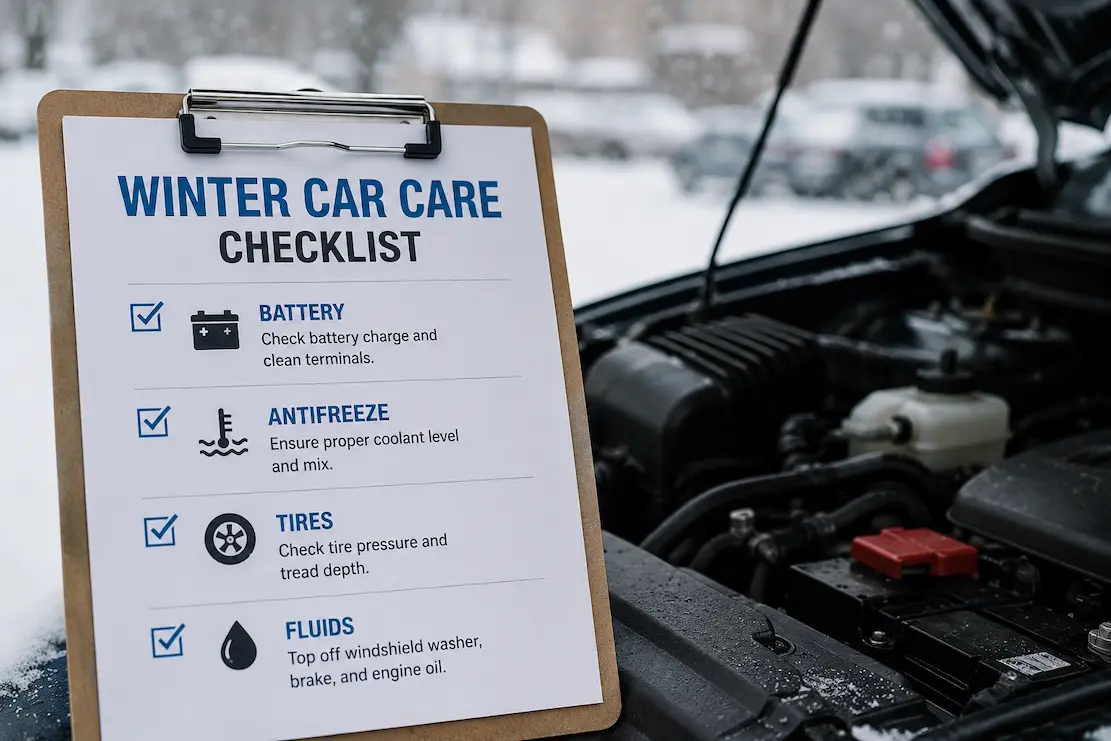
In this checklist, I will walk you through the four systems that matter most when temperatures drop: your battery, antifreeze, tires, and fluids. This is the same routine I run on my own vehicles before the first freeze, and it has kept me from being stranded more times than I can count.
Why Winter Hits Cars Harder Than Most People Realize
Cold weather is not just uncomfortable for you. It is actively hostile to your car. Engine oil thickens. Rubber seals contract. Metal shrinks slightly, changing clearances. Batteries lose capacity. Tire pressure drops. And the worst part is that these problems stack on top of each other. A weak battery that barely started your car in September will not start it at all in January.
The good news is that most winter failures are preventable with a few hours of attention in the fall. You do not need a heated garage or expensive tools. You just need to know what to check and what the numbers actually mean.
The Battery: Your Weakest Link in Cold Weather
Car batteries lose about 35 percent of their cranking power at 32 degrees Fahrenheit and up to 60 percent at zero degrees. That is not a small drop. It is the difference between a normal start and silence when you turn the key.
A battery that tests fine in warm weather can be borderline in cold weather. The cold does not damage the battery directly, but it reveals weakness that was already there.
How to Test Your Battery Before Winter
- Visual inspection: Look for corrosion on the terminals. White or green crusty buildup creates resistance. Clean it with a wire brush and a baking soda solution.
- Load test: Most auto parts stores will test your battery for free with a load tester. This simulates the draw of starting the engine and tells you if the battery can handle it.
- Voltage check: A fully charged battery should read 12.6 volts or higher with the engine off. Below 12.4 volts means it is partially discharged. Below 12.0 volts means it is deeply discharged and may be damaged.
- Age check: Most batteries last three to five years. If yours is over four years old, plan to replace it before winter regardless of how it tests.
Pro Tip: If your car sits unused for days at a time in winter, consider a battery maintainer (trickle charger). It keeps the battery at full charge without overcharging. A $30 maintainer can save you from a $150 tow and a $120 battery replacement.
When to Replace vs. When to Recharge
| Battery Condition | What It Means | Action |
|---|---|---|
| 12.6+ volts, passes load test, under 4 years old | Healthy battery | Clean terminals, check connections, monitor |
| 12.4-12.5 volts, marginal load test | Aging or partially discharged | Recharge fully, retest, and plan replacement if over 3 years old |
| Below 12.0 volts, fails load test | Weak or failing cell | Replace before winter; do not risk it |
| Over 5 years old regardless of test | End of typical lifespan | Replace proactively; cold will finish it off |
Antifreeze: The Fluid That Keeps Your Engine Alive
Antifreeze, also called coolant, does two jobs. In summer it prevents overheating. In winter it prevents freezing. If your coolant freezes in the block, it expands and can crack the engine casting. That is a catastrophic failure that totals most cars.
The protection level of your coolant is measured by its freeze point. A 50/50 mix of antifreeze and water protects down to about minus 34 degrees Fahrenheit. A 70/30 mix pushes that to minus 64 degrees, but it reduces heat transfer efficiency, so most manufacturers stick with 50/50.
How to Check Your Antifreeze Strength
A coolant hydrometer or refractometer is the right tool for this. You can buy one for under ten dollars. Suck some coolant from the radiator or overflow tank and read the freeze point on the scale. If it is weaker than minus 30 degrees Fahrenheit, drain some coolant and add straight antifreeze until the mix is correct.
Do not guess by color. Green, orange, pink, and blue coolants all exist, and mixing incompatible types can create sludge that clogs your radiator. Use the type specified in your owner’s manual.
Coolant System Inspection Points
- Radiator hoses: Squeeze them when the engine is cold. They should feel firm but flexible. Cracks, bulges, or mushy spots mean replacement.
- Radiator and heater core: Look for wet spots, stains, or crusty residue around connections. Any leak will get worse when the system pressurizes in cold starts.
- Pressure cap: A weak cap lets coolant escape as steam, lowering the boiling point and reducing freeze protection. Caps are cheap. Replace them every few years.
- Coolant level: Check the overflow tank when the engine is cold. The level should be between the min and max marks. Low level means a leak somewhere.
Warning: Never open a hot radiator cap. The system is pressurized and the coolant is near boiling. Wait until the engine is completely cold. If you are unsure, check the overflow tank instead.
Tires: The Only Thing Between You and the Road
All-season tires are a compromise. They work adequately in a wide range of conditions but excel in none. When temperatures drop below 45 degrees Fahrenheit, the rubber compound in all-season tires hardens and loses grip. Winter tires are made from a softer compound that stays flexible in the cold, and they have tread patterns designed to bite into snow and channel slush away.
Winter Tires vs. All-Season Tires in Cold Weather
| Factor | All-Season Tires | Winter Tires |
|---|---|---|
| Rubber compound | Hardens below 45°F | Stays flexible to well below zero |
| Tread pattern | General purpose | Deep grooves, sipes for snow and ice |
| Braking on snow | Significantly longer stopping distance | Up to 40% shorter stopping distance |
| Cost | No extra cost | $400-800 for a set, plus storage |
| Best for | Mild winters, occasional light snow | Consistent cold, heavy snow, icy roads |
My personal rule: if you live where temperatures stay below freezing for more than a month or where snow and ice are regular, winter tires are worth the investment. They are not just for snow. They outperform all-seasons in cold, dry conditions too.
Tire Pressure Drops in Cold Weather
For every 10 degrees the temperature drops, tires lose approximately 1 PSI (pound per square inch) of pressure. A tire that was properly inflated at 70 degrees will be several PSI lower at 20 degrees. Underinflated tires wear unevenly, reduce fuel economy, and handle poorly on slick surfaces.
Check your tire pressure at least once a week in winter. Do it when the tires are cold, before you have driven more than a mile. Use the pressure listed on the driver’s door jamb or owner’s manual, not the number molded into the tire sidewall.
Fluids: Everything Thickens When It Gets Cold
Engine oil, transmission fluid, power steering fluid, and even windshield washer fluid all behave differently in cold weather. Some need to be changed to winter-grade formulations. Others just need to be at the correct level.
Engine Oil in Winter
Thick oil is harder to pump and harder to circulate when cold. That means more wear on startup, when most engine damage occurs. If your owner’s manual allows it, switching to a lower winter viscosity can help.
- 5W-30 or 0W-20: Common winter grades that flow better at low temperatures
- 10W-30: May be too thick for very cold climates; check your manual
- Synthetic oil: Flows better in cold weather than conventional oil; worth the extra cost if you live in a cold region
If you are due for an oil change in the fall, do it before the cold sets in. Fresh oil with the right viscosity will protect your engine better on those brutal January mornings.
Windshield Washer Fluid
Regular washer fluid freezes at about 32 degrees. If you use it in winter, it will ice up your spray nozzles and potentially crack the reservoir. Switch to winter-grade washer fluid with antifreeze properties, rated for at least minus 20 degrees. In extreme climates, look for fluid rated to minus 40.
Transmission and Power Steering Fluids
These do not usually need seasonal changes, but they should be at the correct level. Low transmission fluid can cause harsh shifting when cold. Low power steering fluid makes the pump work harder, which is especially noticeable on cold mornings when the fluid is thickest.
Pro Tip: Keep an emergency kit in your trunk during winter. Include a blanket, flashlight, jumper cables, a small shovel, sand or kitty litter for traction, and a phone charger. If you do get stranded, you will be glad you prepared.
The Full Winter Prep Checklist
Here is the routine I run on every car in my household before the first hard freeze. Print it, check items off, and you will head into winter with confidence.
| System | What to Check | When to Act |
|---|---|---|
| Battery | Voltage, load test, terminal condition, age | Replace if over 4 years old or marginal test |
| Antifreeze | Freeze point with hydrometer, level, hose condition | Adjust mix if weaker than -30°F; replace hoses if cracked |
| Tires | Pressure weekly, tread depth, wear pattern | Install winter tires if temps stay below 45°F regularly |
| Engine Oil | Level, color, viscosity grade vs. climate | Change to winter-grade synthetic if due |
| Washer Fluid | Type and level | Switch to winter-rated fluid before first freeze |
| Wiper Blades | Rubber condition, streaking, noise | Replace if older than 1 year or showing wear |
| Defroster and Heater | Output temperature, fan speed, window clearing | Diagnose if weak; could be thermostat or heater core |
| Exhaust System | Leaks, rust, holes, especially near cabin | Repair immediately: carbon monoxide risk with windows up |
What to Do If Your Car Will Not Start on a Cold Morning
Even with perfect preparation, extreme cold can overwhelm a marginal battery. Here is the right way to handle it without causing more damage:
- Do not crank for more than 10 seconds. Extended cranking overheats the starter and drains the battery further. Wait 30 seconds between attempts.
- Turn off all accessories. Headlights, heater, radio, and phone chargers all draw power. Give the battery every amp for starting.
- Try a jump start. If you have cables and a helper, connect positive to positive, negative to a metal ground on the dead car, not the battery terminal. Run the helper car for a few minutes before cranking.
- If it still will not start, the battery may be too far gone or there may be another issue. Call for a tow or roadside assistance rather than repeatedly draining a dead battery.
Common Winter Car Care Mistakes
Over the years, I have seen the same errors repeated every winter. Avoid these:
- Warming up the car for 20 minutes: Modern engines do not need extended idling. It wastes fuel, creates condensation in the oil, and does not warm the car faster than driving gently. Thirty seconds to a minute is enough.
- Using hot water on a frozen windshield: The rapid temperature change can crack the glass. Use a plastic scraper and defroster instead.
- Ignoring the tire pressure light: It is probably not a leak. It is the cold. Fill the tires and monitor. If the light comes back on after warming up, then you have a leak.
- Skipping the garage because the car is fine: Even a carport helps. Wind chill accelerates battery drain and makes the engine harder to start.
Remember: Winter car care is not about spending money. It is about spending attention. A $10 hydrometer, a $5 tire pressure gauge, and 30 minutes of inspection can prevent a $500 tow bill and a ruined morning.
Final Thoughts
Winter does not have to be the enemy of your car. With a methodical approach to battery health, coolant strength, tire condition, and fluid levels, you can drive through the coldest months with the same confidence you have in summer. The key is doing the work before the temperature drops, not after you are already stuck.
Start with the battery. It is the most likely failure point. Then move through coolant, tires, and fluids. By the time the first snow falls, you will know your car is ready. And that peace of mind is worth every minute you spend in the garage in October.
Related Articles
- Stepwise Method to Keep Your Car Battery Healthy in Winter
- How to Maintain Tire Pressure for Better Fuel Efficiency
- Practical Tips to Extend the Life of Your Car’s Cooling System
- How to Check and Replace Engine Oil Without Visiting a Mechanic
- Car Maintenance Guide: Prevent Breakdowns With Simple Routines
- How to Replace Wiper Blades Quickly and Safely
- How I Handle Unusual Car Behavior During Cold Starts
- Why Your Car Won’t Start: Step-by-Step Troubleshooting Guide
Sources and References
- NHTSA (National Highway Traffic Safety Administration). «Winter Driving Safety Tips.» https://www.nhtsa.gov/road-safety/winter-driving-safety-tips
- Consumer Reports. «Winter Car Care: Battery, Tires, and Fluids.» https://www.consumerreports.org/cro/cars/tires-car-care/winter-car-care/index.htm
- Car and Driver. «The Real Difference Between Winter and All-Season Tires.» https://www.caranddriver.com/features/a15103318/winter-vs-all-season-tires/
- Popular Mechanics. «How to Winterize Your Car: A Complete Guide.» https://www.popularmechanics.com/cars/how-to/a3110/1272376/
- Edmunds. «Winter Car Care Checklist.» https://www.edmunds.com/car-maintenance/winter-car-care.html
- Battery Council International. «Car Battery Performance in Cold Weather.» https://www.batterycouncil.org/
- SAE International. «Engine Oil Viscosity and Cold Weather Performance.» SAE J300. https://www.sae.org/standards/content/j300_201501/
- U.S. Department of Energy. «Fuel Economy in Cold Weather.» https://www.fueleconomy.gov/feg/coldweather. shtml
About the author: This article was written by a hands-on automotive enthusiast with over fifteen years of experience maintaining vehicles through harsh winters. All recommendations are based on practical field experience combined with manufacturer guidelines and industry safety standards.

Written by Michael Reyes, part of the FallasDeAutos editorial team. Michael focuses on helping car owners understand and fix common vehicle problems with simple, practical guidance. His content covers diagnostics, maintenance, and troubleshooting, making complex automotive issues easier to understand. He aims to provide clear, reliable information that helps readers make informed decisions while encouraging consultation with qualified mechanics when needed.