Last updated: June 9, 2026
Brakes are the one system on your car that you never want to think about failing. Yet most drivers only pay attention to them when something goes wrong — a squeal, a grind, or worse, a soft pedal that takes too long to stop the car. I have been doing my own brake work for over a decade, and I can tell you that the difference between a safe stop and a close call often comes down to maintenance habits that cost very little but require a bit of attention.
In this guide, I will walk you through every part of the brake system — pads, rotors, fluid, and lines — and explain what to check, when to replace, and how to spot trouble before it becomes dangerous. This is not about turning you into a mechanic. It is about knowing enough to keep your car safe and avoid getting overcharged at a shop.
Why Brake Maintenance Gets Ignored
Brakes do not have a dashboard light that screams for attention like a check engine light. They wear gradually. You adapt to the feel without realizing it. By the time you hear grinding, the pads are usually gone and the rotors are getting damaged. That is why a proactive approach matters more here than almost anywhere else on the car.
Here is the reality: brake pads are designed to wear out. That is their job. They sacrifice themselves so your rotors do not. The trick is replacing them before they take the rotors down with them.
Understanding Your Brake System
Most cars on the road today use disc brakes on the front wheels and either disc or drum brakes on the rear. The front brakes do about 70 percent of the stopping work because weight shifts forward when you brake. That is why front pads wear faster than rear pads.
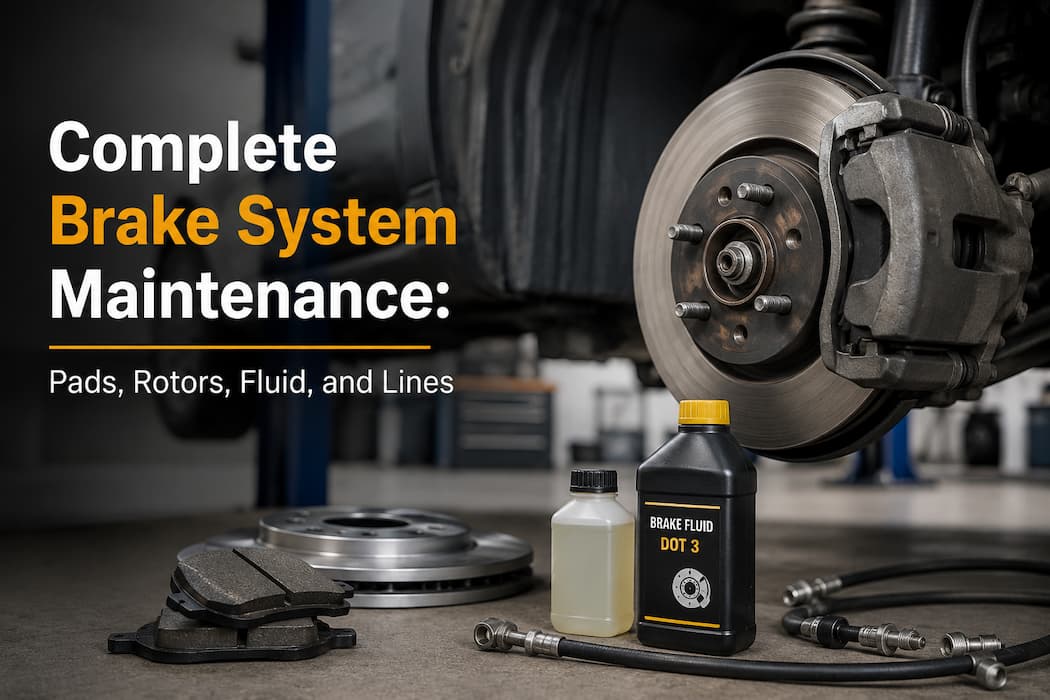
The basic disc brake setup includes four main components:
- Brake pads: The friction material that presses against the rotor to slow the wheel
- Rotors (discs): The metal discs that spin with the wheel and provide the surface for the pads to grip
- Brake fluid: The hydraulic fluid that transfers force from your foot pedal to the calipers
- Brake lines and hoses: The tubes that carry pressurized fluid from the master cylinder to each wheel
Each of these wears or degrades differently, and each needs its own inspection schedule.
Brake Pads: The First Line of Defense
How to Know When Pads Are Wearing Thin
Most brake pads have a built-in wear indicator — a small metal tab that contacts the rotor once the pad material gets down to about two to three millimeters. That contact creates a high-pitched squeal designed to alert you before damage occurs.
If you ignore the squeal, the next sound is grinding. That means the pad backing plate is digging into the rotor. At that point, you are looking at rotor replacement too, not just pads.
Visual Inspection
On many cars, you can see the outer pad through the wheel spokes. Look for the pad material pressed against the rotor. If the material looks thinner than a quarter inch, it is time to plan a replacement. Some pads also have a slot down the middle that acts as a visual wear indicator.
Pad Thickness Guidelines
| Pad Thickness | Condition | Action Needed |
|---|---|---|
| 12 mm or more | New or recently replaced | None; check again in 6 months |
| 6-8 mm | Moderate wear | Monitor closely; plan replacement within 6-12 months |
| 3-4 mm | Near end of life | Replace soon, within 1,000-2,000 miles |
| Less than 2 mm | Critical: metal backing plate exposed | Replace immediately and inspect rotors for damage |
Warning Sign: If your brake pedal feels spongy, sinks lower than usual, or the car pulls to one side when braking, do not wait for a scheduled inspection. These symptoms indicate a fluid leak, caliper issue, or uneven pad wear. Get it checked immediately.
Rotors: When to Resurface and When to Replace
Rotors are the metal discs that your brake pads clamp onto. They are built to last through multiple pad changes, but they do wear down over time. Heat, friction, and rust all take their toll.
Measuring Rotor Thickness
Every rotor has a minimum thickness specification stamped on the edge or hub, usually measured in millimeters. If a rotor is worn below that number, it cannot dissipate heat properly and becomes a safety risk. A micrometer or caliper is the right tool for this measurement.
Common Rotor Problems
- Scoring or grooves: Caused by worn pads or debris embedded in the pad material. Light scoring is normal; deep grooves mean replacement.
- Warping: Usually caused by overheating from hard braking or riding the brakes downhill. You feel this as a pulsing brake pedal or steering wheel vibration.
- Rust and pitting: Common in humid climates or on cars that sit unused. Surface rust often cleans off after a few brake applications. Deep pitting requires replacement.
- Cracks: Any visible crack means the rotor is done. Do not attempt to resurface or reuse it.
Resurfacing vs. Replacement
Resurfacing (also called turning or machining) removes a thin layer of metal to create a smooth, flat surface. It is cheaper than replacement, but it only works if the rotor is thick enough to stay above the minimum specification after machining. Many shops now skip resurfacing entirely and recommend replacement because modern rotors are thinner from the factory and often do not have enough material left to turn.
My personal rule: if the rotor is near minimum thickness, has deep scoring, or shows any warping, I replace it. The cost difference is not worth the risk of a brake failure.
Brake Fluid: The Hidden Wear Item
Brake fluid is hygroscopic, which means it absorbs moisture from the air over time. This is not a theory — it is chemistry. Even in a sealed system, moisture finds its way in through microscopic gaps and the rubber seals in the master cylinder and calipers.
Why does moisture matter? Because water in brake fluid lowers its boiling point. Under heavy braking, brake temperatures can exceed 300 degrees Fahrenheit. If the fluid boils, it creates vapor bubbles in the lines. Vapor compresses. Your pedal goes to the floor. That is brake fade, and it is terrifying.
When to Change Brake Fluid
Most manufacturers recommend a brake fluid change every two to three years, regardless of mileage. Some European brands push it to every two years strictly. I follow the two-year rule because brake fluid is cheap, and a brake failure is not.
How to Check Brake Fluid Condition
- Color: Fresh fluid is clear to light amber. Dark brown or black fluid is contaminated and needs changing.
- Clarity: Cloudy or murky fluid indicates moisture or contamination.
- Level: The reservoir has min and max lines. Low fluid can mean worn pads (the caliper pistons extend farther, drawing more fluid) or a leak.
Pro Tip: Never mix different types of brake fluid. Most cars use DOT 3 or DOT 4. Some high-performance vehicles use DOT 5 or DOT 5.1. Check your reservoir cap or owner’s manual. Mixing incompatible fluids can damage rubber seals and cause complete brake failure.
Brake Lines and Hoses: The Overlooked Components
Rubber brake hoses flex every time your wheels turn and your suspension moves. Over years of heat cycles and ozone exposure, they harden, crack, and can develop internal blockages. Steel lines can rust from the inside out, especially in regions that use road salt.
What to Look For
- Cracks or bulges in rubber hoses: Replace immediately. A bulge means the inner lining has failed and the outer casing is holding pressure by a thread.
- Wet spots or drips on lines or fittings: Indicates a leak. Even a slow leak will eventually lead to air in the system and a soft pedal.
- Rust on steel lines: Surface rust is cosmetic. Flaking or pitted rust is structural. Replace the line.
- Soft or spongy pedal feel: Often caused by air in the lines from a leak or by deteriorating rubber hoses that expand under pressure instead of transmitting force.
A Practical Brake Inspection Schedule
Here is what I do on my own cars and recommend to anyone who wants to stay ahead of brake problems:
| Interval | What to Check | What to Look For |
|---|---|---|
| Every oil change | Pad thickness, rotor condition, fluid level | Thin pads, scoring, low fluid, leaks |
| Every 6 months | Brake hoses, steel lines, caliper function | Cracks, bulges, rust, uneven pad wear |
| Every 2 years | Brake fluid condition and replacement | Dark color, moisture contamination, low boiling point |
| Every 30,000-50,000 miles | Full brake system inspection | Comprehensive check of all components |
Signs That Mean Stop Driving and Fix It Now
Some brake symptoms are warnings. Others are emergencies. Know the difference:
- Grinding noise: Pads are gone. Rotors are being damaged. Stop driving.
- Brake pedal goes to the floor: Fluid leak or master cylinder failure. Do not drive. Tow the car.
- Car pulls hard to one side when braking: Caliper is stuck, pad is worn unevenly, or fluid is contaminated on one side. Risk of spinning out.
- Burning smell after braking: Overheated brakes. Let them cool. If it happens regularly, your pads or fluid is not up to the task.
- ABS warning light stays on: Anti-lock system is disabled. Your brakes still work, but emergency stopping performance is reduced. Get it diagnosed soon.
Safety Note: If you ever feel uncertain about your brakes, do not guess. A brake inspection at a reputable shop costs very little compared to the cost of an accident. When in doubt, get it checked out.
Doing Basic Brake Work Yourself
Replacing brake pads is one of the most accessible DIY jobs on a car. You need basic hand tools, a jack and jack stands, and a C-clamp or brake caliper tool to compress the piston. The process is straightforward: remove the wheel, remove the caliper, swap the pads, compress the piston, reinstall everything, and bed the brakes with a few controlled stops.
Rotor replacement adds a few steps — removing the caliper bracket, sliding the rotor off the hub, cleaning the hub surface, and installing the new rotor. Always clean the new rotor with brake cleaner before installation to remove the protective oil coating.
Brake fluid replacement is more involved because you must bleed the system to remove air. This requires a helper or a one-person bleeder tool, and you must follow the correct bleeding sequence for your vehicle. If you are not comfortable with this, a shop can do a fluid flush for a reasonable price.
Cost vs. Safety: The Real Math
A set of quality brake pads costs between thirty and eighty dollars. Rotors run forty to a hundred dollars each. Brake fluid is under twenty dollars a bottle. Even if you pay a shop for labor, a full brake service on most cars runs between two and four hundred dollars.
Compare that to the cost of an accident caused by brake failure, or the cost of replacing calipers, master cylinders, and damaged suspension components because you let pads grind into rotors and overheat the entire system. Maintenance is always cheaper than repair.
Final Thoughts
Your brakes are not a place to cut corners or delay maintenance. The good news is that brake care is not complicated. A quick visual inspection every few months, attention to how the pedal feels, and a disciplined schedule for fluid changes will keep your stopping power reliable for the life of the car.
Learn what normal feels like for your car. When something changes — a new noise, a different pedal feel, a pull to one side — investigate it. The earlier you catch a brake problem, the cheaper and safer it is to fix.
Remember: Brake pads are a wear item by design. They are supposed to be replaced. The question is not whether you will replace them, but whether you will replace them before they take the rotors, calipers, and your safety down with them.
Related Articles
- Step-by-Step Guide to Inspect Brake Pads Before They Wear Out
- Car Vibrates When Braking: Causes and Fixes
- Car Shakes While Driving: Causes and Fixes Explained
- Car Maintenance Guide: Prevent Breakdowns With Simple Routines
- How to Check and Replace Engine Oil Without Visiting a Mechanic
- Practical Tips to Extend the Life of Your Car’s Cooling System
- Easy Routine to Keep Car Air Filters Performing Well
- How to Maintain Tire Pressure for Better Fuel Efficiency
Sources and References
- NHTSA (National Highway Traffic Safety Administration). «Brake System Safety and Inspection Guidelines.» https://www.nhtsa.gov/vehicle-safety/brake-system
- SAE International. «Brake Fluid Standards and Performance Requirements.» SAE J1703, J1704. https://www.sae.org/standards/
- Consumer Reports. «When to Replace Brake Pads and Rotors.» https://www.consumerreports.org/cro/cars/tires-car-care/brakes.htm
- Car and Driver. «How to Check Your Brakes and Know When to Replace Them.» https://www.caranddriver.com/features/a27169631/how-to-check-brakes/
- Popular Mechanics. «DIY Brake Pad and Rotor Replacement Guide.» https://www.popularmechanics.com/cars/how-to/a3110/1272241/
- Edmunds. «Brake Maintenance: What You Need to Know.» https://www.edmunds.com/car-maintenance/brake-maintenance.html
- DOT (Department of Transportation). «Motor Vehicle Brake Fluid Specifications.» FMVSS No. 116. https://www.nhtsa.gov/laws-regulations/fmvss
- ASE (National Institute for Automotive Service Excellence). «Brake System Certification Study Guide.» https://www.ase.com/
About the author: This article was written by a hands-on automotive enthusiast with over ten years of experience performing brake maintenance, suspension work, and general repairs on personal vehicles. All recommendations are based on practical field experience combined with manufacturer guidelines and industry safety standards.

Written by Michael Reyes, part of the FallasDeAutos editorial team. Michael focuses on helping car owners understand and fix common vehicle problems with simple, practical guidance. His content covers diagnostics, maintenance, and troubleshooting, making complex automotive issues easier to understand. He aims to provide clear, reliable information that helps readers make informed decisions while encouraging consultation with qualified mechanics when needed.