
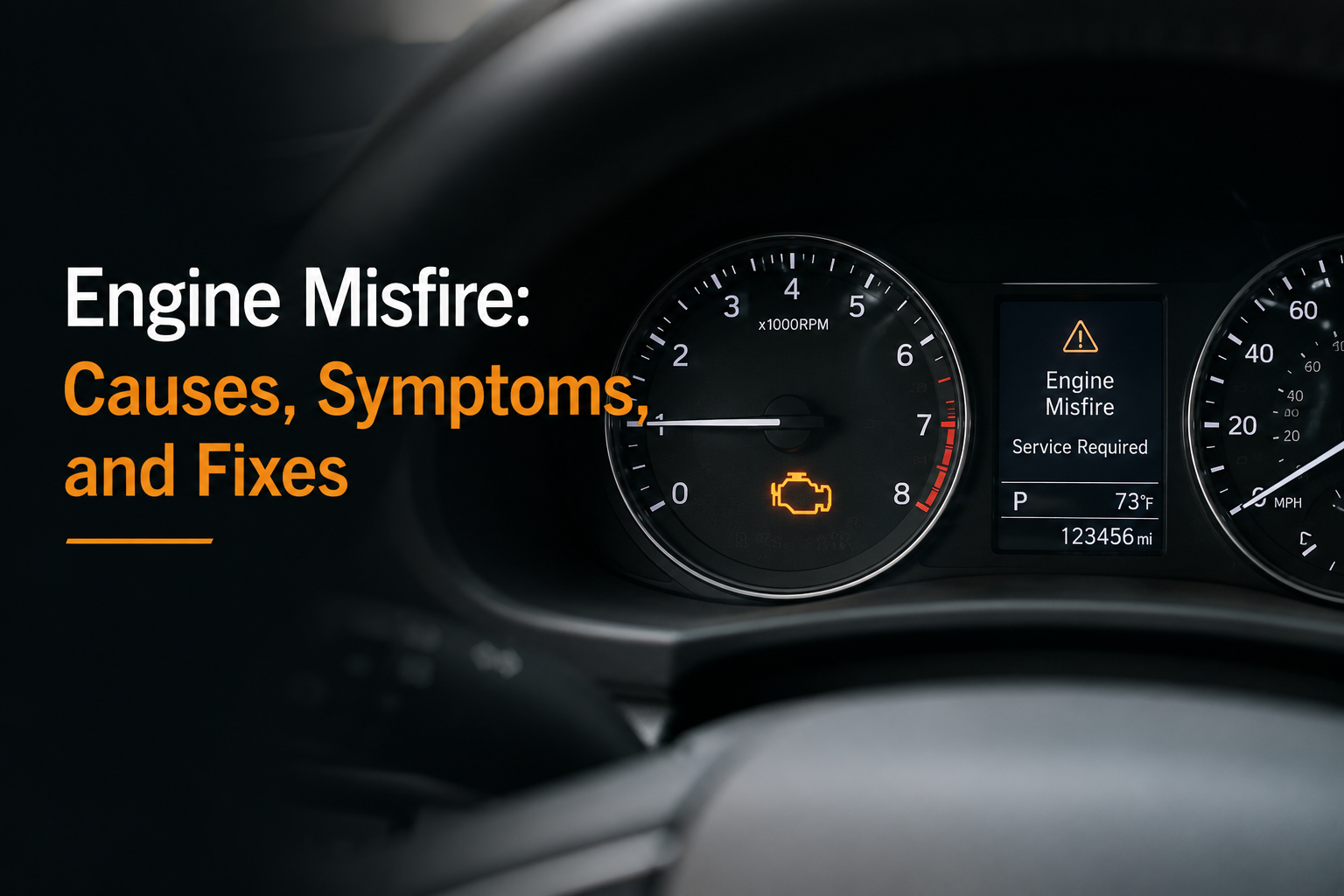
You’re driving normally, maybe heading to work or running errands, and suddenly your car starts shaking, losing power, or making an odd sputtering sound. It feels like something is “off”, but you can’t quite tell what. An engine misfire often causes that uncomfortable feeling.
An engine misfire happens when one or more cylinders in your engine fail to fire properly. Instead of smooth, controlled combustion, the engine stumbles—and you feel it instantly. It’s one of those issues that can start small but quickly turn into something serious if ignored.
In this guide, I’ll walk you through what causes engine misfires, how to recognise the symptoms early, and what you can actually do to fix the problem—even if you’re not a mechanic.
What Is an Engine Misfire?
Before diving into causes, let’s simplify what’s happening.
Your engine relies on three main elements to run properly:
- Air
- Fuel
- Spark
When these are delivered in the right amounts and at the right time, combustion happens smoothly. But if even one of these elements is disrupted, the cylinder won’t fire correctly—this event is a misfire.
Think of it like cooking: if you forget an ingredient or mess up the timing, the final result won’t be right.
Common Causes of Engine Misfire
There isn’t just one reason your engine might misfire. In fact, there are several possible causes—some simple, others more complex.
Faulty Spark Plugs
Spark plugs are responsible for igniting the air-fuel mixture. Over time, they wear out, get dirty, or develop carbon buildup.
When this occurs:
- The spark becomes weak or inconsistent
- The cylinder may fail to fire completely
If you haven’t checked your spark plugs in a while, this is often the first place to look. If you want a deeper breakdown, you can check this guide on faulty spark plugs and replacement signs:
https://fallasdeautos.com/faulty-spark-plugs-signs-and-replacement-guide/
Ignition Coil Problems
Ignition coils supply voltage to the spark plugs. If a coil fails:
- The spark plug won’t receive enough power
- That cylinder will misfire
Modern cars often have one coil per cylinder, so a failure usually affects just one.
Fuel System Issues
If your engine isn’t getting enough fuel—or the fuel isn’t delivered properly—it can misfire.
Common fuel-related causes include:
- Clogged fuel injectors
- Weak fuel pump
- Dirty fuel filter
Fuel delivery problems often lead to rough idling and poor acceleration.
Vacuum Leaks
Your engine depends on precise air intake. A vacuum leak allows extra air to enter the system, throwing off the air-fuel ratio.
Signs include:
- Rough idle
- High RPMs at idle
- Hissing sounds from the engine bay
Low Compression
Each cylinder needs proper compression to ignite fuel. If compression is low due to:
- Worn piston rings
- Damaged valves
- Head gasket issues
…the cylinder won’t fire properly.
This problem is usually a more serious (and costly) cause of misfire.
Sensor or ECU Issues
Modern cars rely heavily on sensors and the engine control unit (ECU).
If a sensor like:
- Oxygen sensor
- Mass airflow sensor (MAF)
- Crankshaft position sensor
malfunctions, it can send incorrect data—leading to misfires.
Symptoms of Engine Misfire
Recognising the symptoms early can save you a lot of money and stress.
Rough Idle
One of the first signs is your car shaking or vibrating when idling. It may feel uneven, almost like the engine is struggling to stay running.
If you’ve noticed similar shaking, you might also find this helpful:
car shakes while driving: causes and fixes explained
https://fallasdeautos.com/car-shakes-while-driving-causes-and-fixes-explained/
Loss of Power
A misfiring engine doesn’t produce full power. You’ll feel:
- Sluggish acceleration
- Hesitation when pressing the gas pedal
Engine Jerking or Stuttering
The car may jerk, especially when accelerating. This is a clear sign that combustion isn’t happening smoothly.
Check Engine Light
In most cases, the check engine light will turn on. Common related codes include:
- P0300 (random misfire)
- P0301–P0308 (specific cylinder misfires)
For a more profound understanding of these codes, you can explore:
P0300 code explained: random misfire causes and fixes
https://fallasdeautos.com/p0300-code-explained-random-misfire-causes-and-fixes/
Poor Fuel Economy
Misfires waste fuel because combustion isn’t efficient. You may notice:
- More frequent trips to the gas station
- Reduced mileage
Step-by-Step Solutions to Fix Engine Misfire
Now let’s talk about what you can actually do.
1. Scan for Error Codes
Start with an OBD2 scanner:
- Plug it into your car
- Check for stored codes
This provides you a direction instead of guessing.
2. Inspect and Replace Spark Plugs
Remove the spark plugs and check for:
- Carbon buildup
- Oil contamination
- Worn electrodes
If they look worn, replace them. It’s one of the cheapest fixes.
3. Check Ignition Coils
If only one cylinder is misfiring:
- Swap the coil with another cylinder
- See if the misfire moves
If it does, the coil is faulty.
4. Examine Fuel Injectors
Listen for clicking sounds from injectors. If one is silent:
- It may be clogged or dead
Fuel injector cleaner can sometimes help, but severe cases need replacement.
5. Look for Vacuum Leaks
Inspect hoses for:
- Cracks
- Loose connections
You can also spray a bit of carb cleaner around hoses—if the RPM changes, there’s likely a leak.
6. Test Compression
If basic fixes don’t work:
- Perform a compression test
Low compression means internal engine problems, which may require professional repair.
7. Check Sensors
Faulty sensors can mislead the ECU. Cleaning or replacing:
- MAF sensor
- Oxygen sensor
…can sometimes resolve the issue.
What I Learned Dealing With a Misfire
In my experience, engine misfires always seem worse than they actually are—at least in the beginning.
I remember once my car started jerking slightly during acceleration. I ignored it for a few days, thinking it was poor fuel. Big mistake.
What worked for me was to start simple. I checked the spark plugs first, and one of them was completely worn out. Replacing it solved the issue instantly.
One mistake I made was assuming it was something expensive right away. In reality, many misfires come down to basic maintenance items.
That experience taught me something important: always verify the simple things before jumping to worst-case scenarios.
Common Mistakes to Avoid
- Ignoring early symptoms like slight jerking or rough idle
- Replacing random parts without proper diagnosis
- Driving too long with a misfire (can damage the catalytic converter)
- Skipping regular maintenance, like spark plug replacement
- Assuming it’s always a major engine problem
Pro Tips for Preventing Engine Misfires
- Replace spark plugs at recommended intervals
- Use high-quality fuel to reduce deposits
- Keep your fuel system clean with occasional additives
- Don’t ignore the check engine light—even if the car “feels fine”.
- Regularly inspect hoses and wiring for wear
A little preventive care can help avoid misfires altogether.
FAQs
Can I drive with an engine misfire?
You can, but it’s not recommended. Driving with a misfire can damage your catalytic converter and worsen the problem over time.
How much does it cost to fix a misfire?
It depends on the cause. Spark plugs may cost very little, while issues like low compression or injector failure can be pricier.
Can subpar fuel cause a misfire?
Yes, poor-quality or contaminated fuel can disrupt combustion and lead to temporary misfires.
Will a misfire fix itself?
In rare cases (like temporary fuel issues), it might go away. But most misfires require proper diagnosis and repair.
How do I know which cylinder is misfiring?
An OBD2 scanner will show specific codes like P0301 (cylinder 1), helping you pinpoint the issue quickly.
Conclusion
An engine misfire might feel alarming, but often, it’s manageable—especially if you catch it early. The key is understanding the symptoms, identifying the root cause, and taking action before things get worse.
Start simple: check spark plugs, scan for codes, and inspect basic components. You might be surprised at how often the fix is something small.
And remember, your car always gives warning signs—it’s just about paying attention to them.

Written by Michael Reyes, part of the FallasDeAutos editorial team. Michael focuses on helping car owners understand and fix common vehicle problems with simple, practical guidance. His content covers diagnostics, maintenance, and troubleshooting, making complex automotive issues easier to understand. He aims to provide clear, reliable information that helps readers make informed decisions while encouraging consultation with qualified mechanics when needed.