
The Dashboard That Went Dark at the Worst Moment
It was a Friday evening, raining hard, and I was navigating an unfamiliar intersection when every warning light on my dashboard lit up at once. The radio died. The headlights flickered. The turn signal stopped clicking. For a split second, I thought the entire electrical system had collapsed. Then I remembered the fuse box under the hood and the possibility that one small piece of metal had just saved me from a much bigger problem.
Fuses are the silent guardians of your car’s electrical system. They sit in plastic boxes, doing nothing for years, until something goes wrong. Then they sacrifice themselves, melting a tiny metal strip to break a circuit and prevent fires, melted wires, or destroyed computers. Most people never think about fuses until one fails. When it happens, the symptoms can be dramatic and confusing. The good news is that finding and replacing a blown fuse is one of the simplest repairs you can do yourself. The challenge is knowing which one blew and why.
This guide walks through exactly how I diagnosed my Friday evening blackout, what I learned about fuse systems, and how you can handle the same situation without panic or unnecessary expense. No special training required. Just a flashlight, a basic understanding of what you are looking at, and the patience to work methodically instead of randomly swapping parts.
What a Fuse Actually Does in Your Car
Every electrical component in your car draws power from the battery through a network of wires. If a wire shorts against metal or a component fails internally, the current can spike dramatically. Without protection, that excess current generates heat, melts insulation, and starts fires. The fuse exists to prevent this by being the weakest link in the chain.
Inside every fuse is a metal strip designed to carry a specific amount of current. Exceed that amount, and the strip overheats and breaks. The circuit goes dead. The dangerous current stops. The rest of your car stays safe. It is intentional destruction for the greater good.
Modern cars have multiple fuse boxes. One under the hood protects high-power components like headlights, cooling fans, and the engine control module. One inside the cabin protects lower-power items like the radio, power outlets, and interior lights. Some cars have additional boxes in the trunk, behind the glove compartment, or even under the rear seat. Your owner’s manual shows every location. If you do not have the manual, a quick online search for your year, make, and model plus fuse box location will get you diagrams.
The Fuse Philosophy: A blown fuse is never the problem itself. It is the symptom of a problem. Replacing the fuse without finding the cause is like taking aspirin for a broken arm. The pain might fade briefly, but the real issue remains. My Friday blackout taught me this the hard way. I replaced the blown fuse; everything worked for ten minutes, then it blew again. The fuse was doing its job perfectly. Something downstream was drawing too much current.
Reading the Symptoms Like a Detective
Before opening any fuse box, observe what stopped working. The pattern of failure tells you which circuit to investigate. Random fuse checking wastes time and misses the logic that leads to the real cause.
If a single component died, like the radio or one power window, you are looking at a dedicated circuit for that item. The fuse is easy to find because the diagram labels it clearly. If multiple unrelated components died simultaneously, you are probably dealing with a main power feed or a shared ground connection. These are harder to trace because they affect several circuits at once.
My Friday failure killed the radio, instrument cluster lights, and turn signals all at once. These seemed unrelated until I checked the fuse diagram and found they all shared fuse number twenty-three in the under-dash panel. That one fuse fed a junction that split power to multiple systems. Finding it required understanding the relationship between components, not just replacing fuses blindly.
| Failure Pattern | What It Suggests | Where to Look First | Common Cause |
|---|---|---|---|
| Single component dead | Dedicated circuit fuse blown | Fuse box diagram for that specific item | Component shorted internally or wiring damaged |
| Multiple components dead | Shared fuse or junction point failed | Fuse diagram for common power feeds | Wiring short where multiple circuits pass together |
| Everything electrical weak | Main power supply or battery connection issue | Battery terminals, main fuses, alternator output | Loose battery connection, corroded terminal, failing alternator |
| Intermittent failures | Loose connection or failing fuse holder | Fuse contacts for corrosion or looseness | Corroded fuse clips, poor contact, vibration-induced opening |
| Fuse blows immediately on replacement | Hard short to ground in the circuit | Wiring along the circuit path for bare metal contact | Pinched wire, chafed insulation, failed component creating direct short |
Locating the Right Fuse Box
Most drivers know about the engine compartment fuse box. Fewer know about the interior ones. My car has three. The engine compartment box handles high-amperage items. The driver-side kick panel box handles interior electronics. The trunk box handles the fuel pump and rear accessories. Your car may differ, but the principle is the same. Multiple boxes protect different zones.
The engine compartment box is usually near the battery or along the fender. It has a plastic cover that snaps or screws off. Inside, you will find a mix of blade fuses, cartridge fuses, and sometimes relays. The cover often has a diagram molded into it or printed on a sticker. This diagram is your map. Without it, you are guessing.
The interior fuse boxes hide in creative places. Behind the glove compartment, under the steering column, in the center console, or even inside the trunk lining. The owner’s manual lists every location. If you bought your car used without a manual, search online forums. Someone has posted pictures and instructions for your exact model. This information is free and saves hours of hunting.
My Friday fuse was in the driver-side kick panel. I had to open the door, crouch down, and remove a plastic cover held by two clips. The cover came off with firm pressure. The fuse diagram was on the back of the cover, which I almost missed because it was facing the firewall. Always check both sides of fuse box covers. Manufacturers put diagrams in unexpected places.
Identifying the Blown Fuse Visually
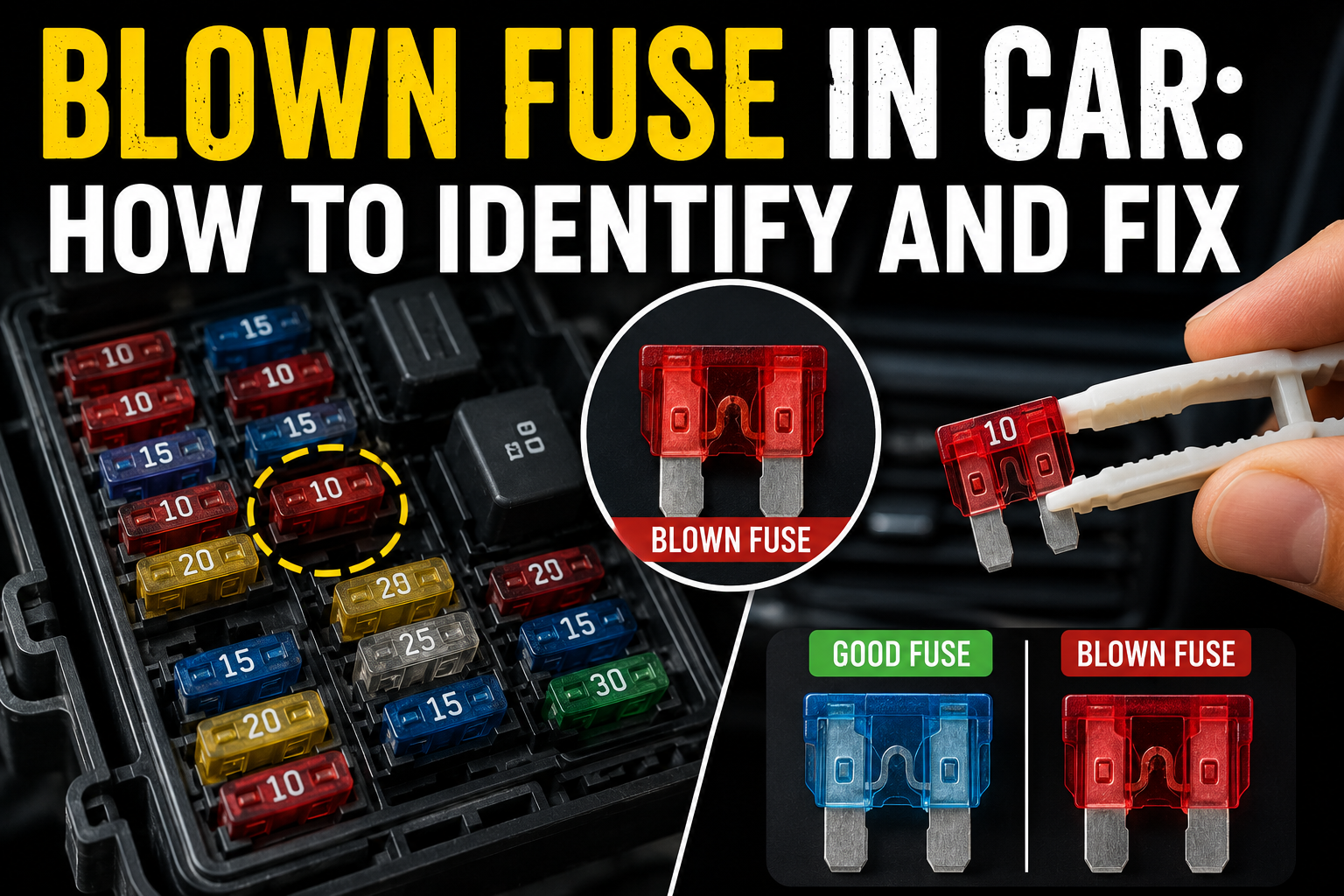
Blade fuses are the most common type. They are small plastic rectangles with two metal prongs and a transparent top. Inside, you see the metal strip that carries current. A healthy fuse shows an unbroken, continuous strip. A blown fuse shows a gap where the strip melted. Sometimes the gap is obvious. Sometimes you need bright light and careful inspection.
Cartridge fuses are cylindrical and harder to inspect visually. They often have a window showing the internal element, but the view is small. A test light or multimeter is more reliable for these. Touch one probe to each end of the fuse with the circuit powered. If the test light does not light, the fuse is open. If you have no test light, a simple continuity check with a multimeter works with the circuit off.
Some fuse boxes include a fuse puller, a small plastic tool that grips the fuse and pulls it out without damage. If yours does not have one, needle-nose pliers work carefully. Do not squeeze hard enough to crack the plastic. A broken fuse in a tight fuse box is frustrating to extract. I learned this when I crushed a fuse with pliers and spent twenty minutes digging out the fragments with a small screwdriver.
The Inspection Trick: Bright sunlight or a flashlight held at an angle makes blown fuse gaps easier to see. Looking straight down through the transparent top sometimes hides the break. Tilt the light so it shines across the metal strip. The gap creates a shadow that becomes obvious. This simple angle change saved me from replacing a good fuse on my first attempt.
Understanding Fuse Ratings and Why They Matter
Every fuse has an amperage rating molded into the plastic top. Five, ten, fifteen, twenty, thirty, and higher. This number is not arbitrary. It represents the maximum current the fuse is designed to carry continuously. Exceed it, and the fuse blows. The rating must match the circuit’s normal operating current plus a safety margin.
Never replace a blown fuse with a higher-rated one. A fifteen-amp fuse blew because the circuit was drawing more than fifteen amps. Putting in a twenty-amp fuse allows that excess current to flow, overheating the wires and potentially starting a fire. The fuse is the safety device. Bypassing its protection defeats the entire purpose.
Never replace a fuse with anything other than a proper fuse. Aluminum foil, copper wire, or a bolt jammed into the fuse holder are all dangerous shortcuts that eliminate protection. People have burned their cars to the ground doing this. The few minutes saved by improvising are not worth the risk of a vehicle fire.
My Friday fuse was a fifteen-amp blade fuse. I had a spare fuse kit in the glove compartment, which I bought for eight dollars after a previous incident. The kit contained common ratings from five to thirty amps. I replaced the blown fifteen with a new fifteen. Everything worked. Then it blew again ten minutes later. That repetition told me the circuit had a real problem, not just a random fuse failure.
Hunting the Cause When Fuses Keep Blowing
A fuse that blows once might be a random failure or a momentary surge. A fuse that blows repeatedly is screaming for attention. The circuit has a short, an overloaded component, or a wiring fault that must be found and fixed.
Start by identifying everything on that circuit. The fuse diagram lists the components, but sometimes the diagram is vague. «Accessory,» «interior lights,» or «miscellaneous» are not helpful descriptions. Search online for your specific fuse number and the symptoms you observed. Forum posts often reveal exactly what components share that fuse and where the common failure points are.
My fuse number twenty-three powered the radio, instrument cluster illumination, and turn signal circuit. The common thread was the wiring harness that ran behind the dashboard. I started by disconnecting the radio. The fuse still blew. I disconnected the instrument cluster connector. The fuse still blew. That narrowed the problem to the turn signal wiring or the flasher module itself.
Tracing wiring requires patience and a wiring diagram. I found a free diagram online for my car’s electrical system. It showed the turn signal circuit running from the fuse, through the flasher module, to the turn signal switch on the steering column, then out to the front and rear bulbs. Any point along that path could be shorting to ground.
I inspected the front turn signal sockets first. Water intrusion is common there, and corrosion can create shorts. The sockets were clean and dry. I checked the rear sockets. Same result. I moved to the steering column and found the problem. The turn signal switch assembly had a cracked housing where the wiring passed through. The insulation on two wires had worn through from years of steering wheel movement. When I turned left, the wires touched metal and shorted. When I turned right, they separated, and the fuse survived. The intermittent nature explained why the fuse did not blow immediately every time.
The Hidden Problem: The cracked switch housing was invisible until I removed the plastic steering column cover. The cover popped off with two screws and gentle prying. The damage was obvious once exposed. The repair was electrical tape around the worn wires and a new switch assembly ordered for forty dollars. The fuse stopped blowing permanently. The real lesson was that the fuse led me to the circuit, but only physical inspection found the actual fault. Data points for you. Eyes confirm.
Using a Test Light for Faster Diagnosis
A test light is a simple tool with a pointed probe and a ground clip. Connect the clip to metal, touch the probe to a powered point, and the light glows if voltage is present. It costs about ten dollars and transforms fuse diagnosis from guessing to certainty.
With the key on, touch the test light to both sides of each fuse slot. Both sides should light on a good fuse. One side lights and the other does not, meaning the fuse is blown. Neither side light means the circuit is not powered, which is normal for circuits that only activate under specific conditions. This method is faster than pulling every fuse for visual inspection, especially in crowded fuse boxes where removal is awkward.
For circuits that only power up with the headlights on, the brake pedal pressed, or the engine running, you need to activate the circuit while testing. Have a helper press the brake while you probe the fuse. Turn the headlights on and check the lighting fuses. This active testing reveals fuses that test fine at rest but fail under load.
I now keep a test light in my car alongside the spare fuse kit. The combination handles most electrical problems without a multimeter or professional help. The test light tells you if power is reaching a component. The fuse kit lets you restore function once the cause is fixed. Together they are a roadside electrical repair kit for under twenty dollars.
Relays: The Big Cousins of Fuses
Near the fuses in most engine compartment boxes, you will find relays. These are electrically operated switches that control high-current circuits using low-current signals. The fuel pump, cooling fans, and starter all use relays because their current draw would melt a simple fuse switch.
Relays can fail too, and their symptoms mimic fuse problems. A bad relay might click but not connect, causing a component to lose power without any fuse blowing. A stuck relay might stay connected, draining the battery or keeping a component running when it should stop. Relays are often interchangeable with identical ones in the same fuse box. Swapping the suspected relay with a known good one is a fast diagnostic test.
My car has identical relays for the cooling fan and the rear window defroster. I never use the defroster in summer. If I suspected a fan relay problem, I could swap them temporarily and see if the symptom moved. This costs nothing and takes thirty seconds. Always check if your fuse box has duplicate relays before buying replacements.
Preventing Fuse Problems Before They Strand You
After my Friday experience, I established a simple maintenance habit. Every six months, I open the fuse boxes and inspect them visually. I look for corrosion on the metal contacts, melted plastic around any fuse slots, and loose fuses that vibrate out of position. I clean the contacts with a small wire brush if they look dull. I tighten any fuse that feels loose.
I also added a fuse kit and test light to every vehicle I own. These are cheap insurance policies. The kit stays in the glove compartment, not the trunk, because electrical problems often prevent the trunk from opening if the release is electronic. Accessibility matters when you are stuck in a parking lot at night.
Finally, I pay attention to electrical symptoms before they become failures. A flickering light, a slow power window, or a radio that cuts out intermittently are often early signs of a failing fuse or loose connection. Addressing these small signals prevents the dramatic blackout that strands you in the rain.
When to Admit Defeat and Call for Help
Some electrical problems exceed DIY capability. Wiring harnesses damaged in collisions, computer modules with internal shorts, and corrosion deep inside sealed connectors require professional tools and expertise. There is no shame in recognizing your limits.
If you have replaced a fuse three times and the problem persists, stop. Repeated fuse replacement without finding the cause risks fire and further damage. If you have traced the wiring as far as you can and the short remains hidden, a shop with wiring diagrams and scan tools may be necessary. If the problem involves the engine control module or anti-lock brake system, professional diagnosis protects expensive components from accidental damage.
The key is arriving with information. Tell the mechanic which fuse blew, what components were affected, and what you have already checked. This saves diagnostic time and money. A professional who knows you have done the groundwork will respect your effort and work with you instead of starting from zero.
What a Blown Fuse Taught Me About My Car
Before that Friday evening, I thought of my car’s electrical system as a black box. Power went in, functions came out, and the details were someone else’s problem. The fuse hunt forced me to understand the relationships between components, the logic of circuit protection, and the physical reality of wires rubbing against metal inside the dashboard.
I learned that fuses are not just disposable parts. They are diagnostic tools. Their behavior tells a story about the health of the circuits they protect. A fuse that blows once is a random event. A fuse that blows repeatedly is a conversation. Learning to listen to that conversation made me a more capable driver and a more confident problem solver.
The cracked turn signal switch would have eventually failed completely, possibly leaving me without signals in heavy traffic. Finding it early, guided by the fuse’s sacrifice, prevented a more dangerous situation. That is the hidden value of paying attention to small failures. They warn you about big ones before they happen.
Sources and References
- Haynes Manuals. (2024). Automotive Electrical Systems: Fuses, Relays, and Circuit Protection. Haynes Publishing.
- Automotive Service Excellence (ASE). (2023). Electrical System Diagnosis and Repair Procedures. Retrieved from https://www.ase.com/
- Car and Driver. (2024). How to Diagnose and Replace Automotive Fuses. Retrieved from https://www.caranddriver.com/features/
- Popular Mechanics. (2023). Automotive Wiring: Short Circuits, Fuse Failures, and Safe Repairs. Retrieved from https://www.popularmechanics.com/cars/
- Edmunds. (2024). Understanding Your Car’s Fuse Boxes and Electrical Protection. Retrieved from https://www.edmunds.com/how-to/
- National Highway Traffic Safety Administration. (2023). Vehicle Electrical System Safety and Fire Prevention. Retrieved from https://www.nhtsa.gov/

Written by Michael Reyes, part of the FallasDeAutos editorial team. Michael focuses on helping car owners understand and fix common vehicle problems with simple, practical guidance. His content covers diagnostics, maintenance, and troubleshooting, making complex automotive issues easier to understand. He aims to provide clear, reliable information that helps readers make informed decisions while encouraging consultation with qualified mechanics when needed.