
The Customer Who Swore His Car Was Haunted
I had a guy come into the shop last summer with a 2017 Ford Escape that he was ready to set on fire. Not literally, but you could see it in his eyes. For three months, his headlights would randomly flicker, the radio would cut out for ten seconds at a time, and the backup camera would go black whenever it rained. Three different shops had replaced the battery, the alternator, and the fuse box. The problem kept coming back.
He sat in my waiting room with his arms crossed while I pulled the car inside. I did not touch the charging system. I did not scan for codes. I started at the front left fender, where the wiring harness passes through the body, and I wiggled the connector while someone watched the headlights. The lights flickered. I pulled the connector apart, and the pins were green with corrosion. Water had been seeping in through a cracked seam sealer for months. Twenty minutes of cleaning, a dab of dielectric grease, and a proper seal, and the car was fine. Total cost: $47.
That is the reality of wiring problems in cars. They are rarely the dramatic failures people imagine. They are quiet and stubborn, and they hide in places you would not think to look. The symptoms look like something else, so everyone replaces the something else, and the real culprit keeps laughing from behithed a fender liner.
Why Wiring Failures Are So Much Worse Than They Used to Be
Twenty years ago, a car might have a few hundred feet of wiring and a handful of connectors. A modern vehicle can have over a mile of wire, dozens of control modules, and hundreds of connectors, each one a potential point of failure. The wiring is thinner now, too. Manufacturers use smaller gauge wire to save weight and cost, which means less copper to carry the current and less tolerance for corrosion or damage.
Then there is the heat. Engine bays are hot, and wiring runs right through them. Plastic insulation becomes brittle over time. Vibrations from the engine and road loosen terminals. Every time you start the car, the harness flexes slightly. Do that ten thousand times, and a wire that was fine yesterday breaks inside its insulation today. You cannot see it. You cannot feel it. But the circuit is open, and something stops working.
Moisture is the other silent killer. Water finds its way into connectors through pinholes in seals, cracked grommets, or poor factory sealing. Once inside, it creates corrosion that increases resistance. The circuit does not fail completely at first. It just gets weaker. A ground that should read zero ohms now reads two ohms. That does not sound like much, but it is enough to make a fuel pump run slow, a sensor read wrong, or a module throw false codes. The customer feels a vague drivability issue. The scanner shows a code for a sensor. The sensor gets replaced. The problem stays because the wiring was the issue all along.
The Symptoms That Scream Wiring Problem
Not every electrical issue is a wiring issue, but some patterns are so consistent that you should check the harness before you touch anything else. Here are the ones I have learned to trust over the years.
Intermittent failures that come and go with no pattern are the classic sign. If a window works on Tuesday, fails on Wednesday, and works again Thursday, the motor is probably fine. The problem is a loose connection, a broken wire inside the door jamb, or a ground that is losing contact. Components do not heal themselves. Connections do, temporarily, when vibration or temperature changes just enough to restore contact.
Flickering lights are another tell. Headlights that dim at idle but brighten when you rev the engine usually point to a charging system issue. But headlights that flicker randomly while driving, or interior lights that pulse when you hit a bump, are almost always a ground problem or a loose connector. The circuit is losing continuity for a split second, and the bulb is the first thing you notice.
A burning smell is the one you never ignore. If a customer mentions a sharp, plastic-like odor, especially after using a high-draw accessory like the rear defroster or power seats, you need to find the hot spot immediately. That smell is insulation melting. It means a wire is carrying more current than it should, either because of a short or because someone in the past used a fuse that was too large. Left alone, it becomes a fire.
Multiple unrelated systems failing at once is a huge clue. If the power windows, the door locks, and the seat heater all quit working together, you do not have three separate problems. You have one power feed or one ground that serves all three circuits. Find the common point, and you find the fix.
Where the Problems Actually Hide
After years of chasing these issues, I have noticed that certain locations fail over and over. It is not random. It is physics and bad design meeting in the same spots.
| Location | Why It Fails | What It Affects |
|---|---|---|
| Door jambs | Wires flex every time the door opens and closes; insulation cracks, conductors break | Power windows, locks, mirrors, speakers, courtesy lights |
| Engine bay near exhaust | Extreme heat degrades insulation; thermal expansion loosens terminals | Oxygen sensors, fuel injectors, ignition coils, cooling fans |
| Under battery tray | Battery acid vapors corrode terminals and nearby harnesses | Starter circuit, main power feeds, ground straps |
| Cowl and windshield base | Water leaks through seals, pools in harness channels, corrodes connectors | Wiper motors, blower fans, instrument cluster, body control module |
| Trunk and rear hatch | Wiring flexes with opening and closing; water intrusion from taillight seals | License plate lights, reverse cameras, trunk release, rear defroster |
| Under carpet near feet | Water from clogged drains or leaks soaks harnesses; salt from winter roads accelerates corrosion | Seat heaters, airbag modules, fuel pump circuits, CAN bus lines |
| Aftermarket accessory taps | Installer cuts into factory harness and uses scotch locks or poor splices that fail with vibration | Whatever circuit they tapped into, plus downstream modules |
The door jamb is probably the worst offender. I have lost count of how many cars I have fixed by peeling back the rubber boot on a door harness and finding three or four wires completely broken, their ends touching sometimes and not touching others. The customer describes it as a ghost in the machine. It is just metal fatigue doing exactly what metal fatigue does.
The Diagnostic Approach Nobody Wants to Hear
Here is the uncomfortable truth about wiring diagnosis: there is no shortcut. You cannot scan your way out of a bad ground. You cannot parts-swap your way out of a broken wire inside a harness. You have to test the circuit, and you have to test it under the conditions where it fails.
Start with a visual inspection, but do it properly. Do not just glance at the battery terminals. Pull the boots off. Look at the wire five inches back from the terminal where corrosion likes to hide. Follow the ground strap to the body and to the engine. If it looks crusty, replace it. Grounds are cheap, and a bad ground will make you chase your tail for hours.
For intermittent issues, you need to recreate the failure. If the problem happens on rough roads, put the car on a lift and tap the harness with a rubber mallet while someone monitors the circuit. If it happens when hot, use a heat gun on suspect connectors and watch for the symptom to appear. If it happens when wet, spray suspect areas with water and see what changes. This is not high-tech work, but it is effective, and it is the only way to find problems that hide from standard testing.
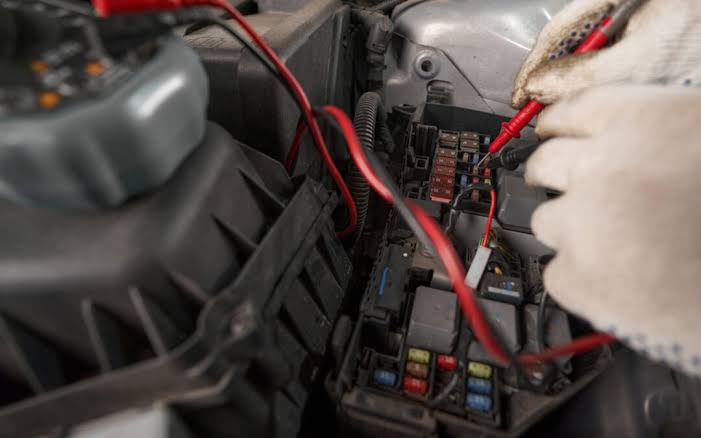
Voltage drop testing is the most underused tool in electrical diagnosis. Most people check voltage at the battery or at the component and call it good. That is not enough. You need to check voltage drop across the entire circuit, including the ground return. A circuit can show twelve volts at the load and still not work if the ground side has two volts of drop. The load sees ten volts, not twelve, and it behaves erratically. The only way to catch this is to put your meter leads on both sides of the circuit and measure the loss while the circuit is active.
Continuity testing with an ohmmeter has its place, but be careful. Never test continuity on a live circuit. Pull the fuse first. And remember that an ohmmeter only tells you if a wire is connected, not if it can carry current. A wire with corroded strands inside the insulation might show perfect continuity with zero ohms on your meter, but under load, the resistance shoots up and the circuit fails. That is why voltage drop testing under load is more reliable than a simple resistance check.
When the Problem Is Not the Wire Itself
Sometimes the wiring is fine, but what is attached to it is not. I see this constantly with aftermarket accessories. Someone installs a remote starter or a dash camera and taps into a factory circuit for power. They use a scotch lock or they pierce the insulation with a vampire clip. Six months later, that connection corrodes, increases resistance, and starts affecting the factory circuit it was parasitically attached to. The customer blames the car. The car is innocent. The installer created the problem.
Another common scenario is circuit overload. A factory circuit is designed for a specific amperage. If someone adds a high-draw accessory to that same circuit without a relay, the wire carries more current than it was sized for. The insulation gets warm. The fuse might not blow if the draw is just under the limit. But over time, the wire degrades, and eventually you get a short or a fire. If you see melted connectors or discolored wires, always check what is connected downstream and whether the load exceeds the circuit’s capacity.
Blown fuses are another clue that people misread. A fuse that blows once might be a random spike. A fuse that blows repeatedly is protecting a circuit that is overloaded or shorted. Replacing the fuse without finding the cause is like taking painkillers for a broken arm. The pain goes away for a minute, but the bone is still broken. Never upsize a fuse to «fix» a recurring blow. The fuse is sized to protect the wire. A larger fuse lets the wire overheat before it opens. That is how cars burn.
Moisture and Flood Damage: The Long Game
Water damage is the most insidious wiring problem because it can take months or years to show up. A car that was in a flood might start and drive fine immediately after. The water drains out. The owner thinks they dodged a bullet. But moisture remains trapped in connectors, inside modules, and under carpet. Corrosion starts slowly. It spreads. Eventually, a pin in a connector loses enough contact resistance that a signal drops out. The module throws a code. The mechanic replaces the module. The problem returns because the connector is still full of green corrosion.
This is why insurance companies totally flood cars. It is not because the engine is hydrolocked. It is because the electrical system is a ticking time bomb. Every connector becomes suspect. Every module is potentially compromised. You can clean and dry what you see, but you cannot see inside a sealed connector or inside a control module. The damage is invisible until it is not.
Even without a flood, routine moisture causes problems. Clogged sunroof drains let water run down the A-pillars and into the dash. Bad windshield seals let water pool at the base of the cowl where the main harness passes through. A missing grommet in the firewall lets engine bay heat and moisture into the cabin. These are not dramatic failures. They are slow, boring, expensive problems that eat hours of diagnostic time because the symptom and the cause are separated by time and distance.
Fixing It Right the First Time
When you do find the bad spot, fix it properly. Soldering is great for a solid connection, but use heat shrink tubing, not electrical tape. Tape unravels with heat and vibration. Heat shrink seals the joint and keeps moisture out. If you are splicing into a harness, use the same gauge wire or slightly larger. Never smaller. If a connector is corroded, replace the whole connector, not just the pin. Pins mate to specific terminals with specific tension. A replaced pin might not seat correctly, and you will be back in the same spot six months later.
Protect the repair. If the original harness had a loom or conduit, put it back. If the wire passes through a hot area, use high-temperature sleeving. If it is near a sharp edge, add a grommet or a protective sleeve. The factory engineers did not randomly choose where to route wires. They avoided heat and abrasion for a reason. Respect that when you make a repair.
And please, for the sake of the next person who works on the car, do not bury a splice inside a harness wrap where nobody can find it. If you must make an in-line repair, position it where it is accessible, and document it. A hidden splice is a time bomb for the next technician, and it is the kind of thing that makes customers lose faith in the entire industry.
What This Means for the Average Car Owner
You do not need to be an electrician to protect yourself from wiring problems. You just need to pay attention to the early signs. If something works sometimes and not others, do not wait for it to fail completely. Intermittent problems are wiring problems until proven otherwise. If you smell something burning, stop driving and get it checked. If you recently had aftermarket work done and now have electrical issues, the work and the issues are probably related.
Keep your battery terminals clean. It sounds basic, but corrosion spreads. It wicks up wires. It attacks connectors. A clean battery is the foundation of a healthy electrical system. Check your grounds, especially if you live in a rust-prone area. A ground strap that looks fine on the outside might be corroded where it bolts to the frame. Remove it, clean it, and bolt it back with a dab of dielectric grease.
And if you are buying a used car, look for signs of past water damage. Check under the carpet for rust stains. Look at the seat bolts for corrosion. Pull the spare tire and look for moisture in the well. These are not guarantees, but they are red flags. A car with a history of water intrusion will have electrical problems. It is not a matter of if. It is a matter of when.
Sources and References
Brake & Front End. «Tech Feature: Solving Intermittent Electrical Problems.» June 23, 2023. https://www.brakeandfrontend.com/tech-feature-solving-intermittent-electrical-problems/
Xtreme Automotive. «Automotive Electrical Problems: Causes, Symptoms, and Complete Repair Guide.» April 13, 2026. https://xtreme-automotive.com/en/blogs/automotive-electrical-problems
Catlett’s Auto Service & Towing. «What Causes Electrical Problems in Cars?» December 16, 2025. https://catletts.com/what-causes-electrical-problems-in-cars-common-issues-every-driver-should-know/
Synchrony. «10 Electrical Problems in Cars Every Driver Should Know.» December 4, 2025. https://www.synchrony.com/blog/automotive/common-electrical-problems
Universal Technical Institute. «Common Car Electrical Problems: Symptoms, Causes & Fixes.» August 3, 2023. https://www.uti.edu/blog/automotive/common-car-electrical-problems
Beacon Automotive Repair. «What Causes Electrical Problems in Your Vehicle and How Can Diagnostics Help?» September 1, 2024. https://www.beaconautomotiverepair.com/what-causes-electrical-problems-in-your-vehicle-and-how-can-diagnostics-help
Approved Garages. «Diagnosing and Fixing Your Car’s Electrical Issues.» September 23, 2024. https://www.approvedgarages.co.uk/news-and-media/diagnosing-fixing-car-electrical-issues

Written by Michael Reyes, part of the FallasDeAutos editorial team. Michael focuses on helping car owners understand and fix common vehicle problems with simple, practical guidance. His content covers diagnostics, maintenance, and troubleshooting, making complex automotive issues easier to understand. He aims to provide clear, reliable information that helps readers make informed decisions while encouraging consultation with qualified mechanics when needed.