
Last updated: June 14, 2026
A few years back, I was helping a friend check out a used car he wanted to buy. The tires looked fine at a glance. Plenty of tread, no obvious bulges, clean sidewalls. But something felt off about the rubber, so I checked the DOT code. The tires were eleven years old. The seller had no idea. He had been driving his family around on rubber that was hard as plastic and ready to fail at highway speed.
That experience stuck with me because it showed how easy it is to miss the real condition of a tire. Tread depth tells part of the story, but age, damage, and wear patterns tell the rest. In this guide, I will walk you through exactly what to look for, what the numbers mean, and when a tire crosses the line from questionable to dangerous.
Why Tires Wear Out in More Ways Than One
Most people think tire replacement is about tread depth. That is the obvious metric, but it is not the only one. A tire with deep tread can still be unsafe if the rubber has aged out, the sidewall is damaged, or the internal structure is compromised. Understanding all three factors — tread, age, and condition — gives you the full picture.
Tires are a wear item by design, but they are also a safety-critical component. The only thing between your car and the road is a patch of rubber about the size of your palm on each wheel. When that rubber fails, everything else fails with it.
Tread Depth: The Quarter Test and Beyond
Tread depth is measured in 32nds of an inch. New tires typically come with 10/32 to 11/32 of tread. As you drive, the tread wears down, reducing grip, water evacuation, and winter performance.
The Legal Minimum vs. The Safe Minimum
In most states, the legal minimum tread depth is 2/32 of an inch. That is the point where wear bars — raised strips built into the tread grooves — become flush with the surrounding tread. But legal and safe are not the same thing. At 2/32, a tire has virtually no ability to channel water away in a heavy rainstorm. Hydroplaning becomes a real risk.
The industry standard for replacement is 4/32 for wet conditions and 6/32 for winter or snow conditions. I replace my tires at 4/32 regardless of season. The cost of early replacement is far less than the cost of an accident.
| Tread Depth | Condition | Recommendation |
|---|---|---|
| 10/32 to 11/32 | New tire | Optimal performance in all conditions |
| 6/32 to 9/32 | Moderate wear | Good for dry and light wet conditions; monitor closely |
| 4/32 to 5/32 | Significant wear | Replace before winter or heavy rain seasons |
| 2/32 to 3/32 | Critical wear | Replace immediately; unsafe in wet conditions |
| Below 2/32 | Bald, illegal in most states | Do not drive; replace before next trip |
How to Measure Tread Depth Accurately
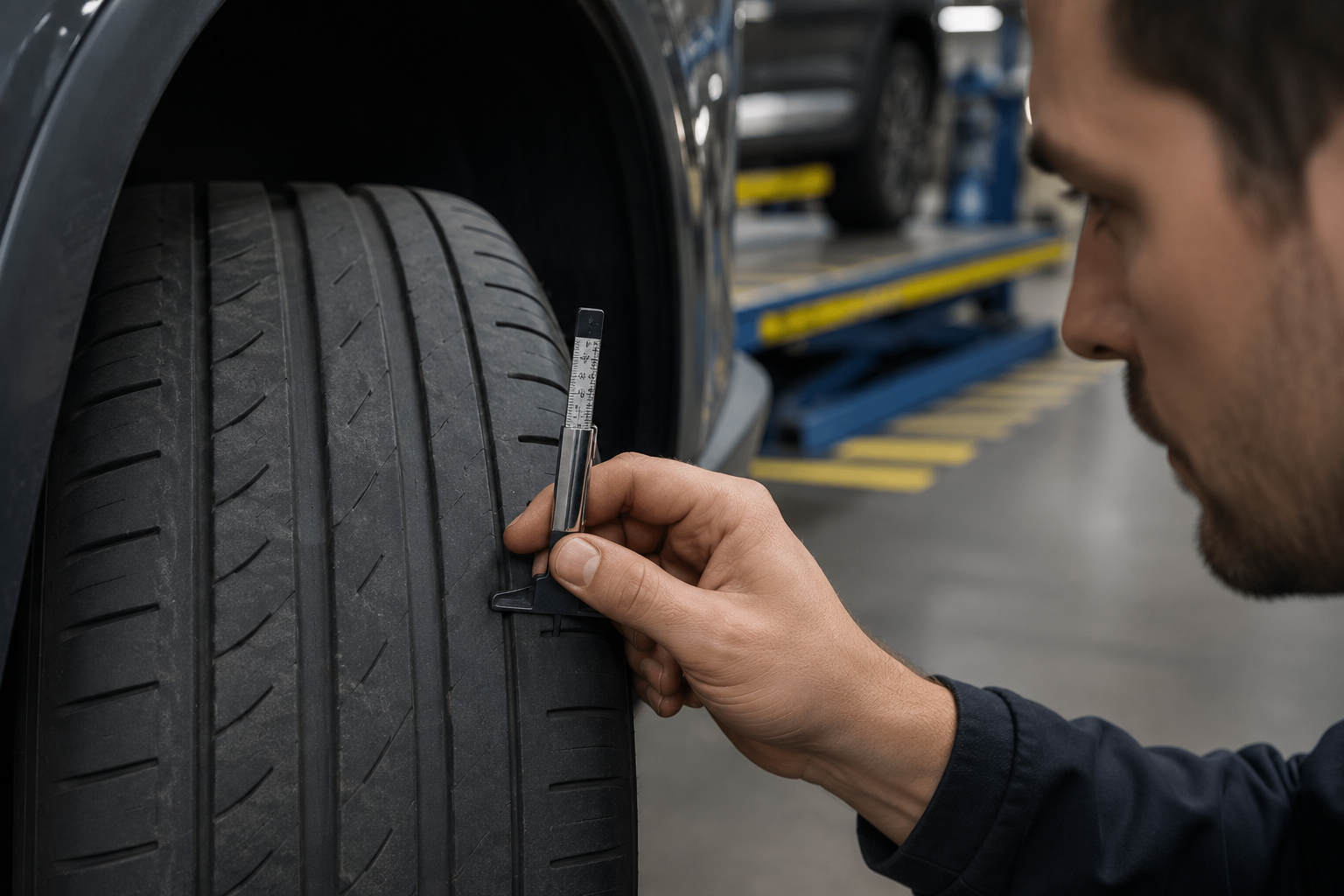
The quarter test is a quick check. Insert a quarter into the tread groove. If you can see the top of Washington’s head, you are at roughly 4/32. A penny test shows 2/32. For accuracy, I prefer a tread depth gauge. They cost about five dollars and give you a precise reading in seconds.
Measure across the width of the tire and around the circumference. Uneven wear — more tread on the inside than the outside, or vice versa — indicates an alignment or suspension problem that needs fixing before you put new tires on.
Pro Tip: Check tread depth in multiple spots on each tire. A tire that measures 6/32 on the outside edge and 3/32 on the inside is not a 6/32 tire. It is a 3/32 tire with an alignment problem. The lowest reading is the one that matters.
Tire Age: The Hidden Killer
Rubber degrades over time, even if the tire has never touched pavement. Heat, ozone, and UV light break down the chemical bonds in the rubber compound. The tire becomes hard, loses elasticity, and develops micro-cracks that can lead to sudden failure.
How to Read the DOT Code
Every tire sold in the United States has a DOT code stamped on the sidewall. It is usually ten to twelve characters long. The last four digits tell you the week and year of manufacture. A code ending in 3219 means the tire was made in the 32nd week of 2019.
Most tire manufacturers recommend replacing tires after six years, regardless of tread depth. Some push that to ten years with annual inspections, but I do not keep tires past six. The risk is not worth the savings.
Signs of Age-Related Degradation
- Cracking on the sidewall: Small cracks in the rubber, often called weather checking, indicate the tire is drying out. Deep cracks mean the structure is compromised.
- Hard, glazed surface: Run your hand over the tread. New rubber feels slightly tacky and soft. Aged rubber feels hard and smooth, almost polished.
- Discoloration: A grayish or brownish tint on the sidewall instead of deep black suggests oxidation and UV damage.
- Vibration at speed: As rubber hardens, it does not absorb road imperfections as well. A tire that suddenly develops a vibration may be aging out, even if the tread looks fine.
Important: Spare tires age too. A full-size spare tucked in the trunk for eight years is not a spare anymore. It is a liability. Check the DOT code on your spare the next time you clean out the trunk. If it is over six years old, replace it even if it has never been used.
Damage Signs That Mean Immediate Replacement
Some tire damage is obvious. Some is subtle. All of it matters.
Bulges and Blisters
A bulge on the sidewall or tread area means the internal reinforcing cords have separated or broken. Air is pushing the rubber outward from the inside. This is a blowout waiting to happen. There is no repair for a bulge. The tire must be replaced immediately.
Cuts and Punctures
A nail in the tread can often be repaired with a patch-plug combination if the puncture is in the tread area and smaller than a quarter inch. But punctures in the sidewall cannot be safely repaired. The sidewall flexes too much for a patch to hold, and the structural damage is usually more extensive than it looks.
Similarly, cuts that expose the internal cords or belts mean the tire is done. Even if it holds air, the structural integrity is gone.
Exposed Belts or Cords
If you can see fabric or steel cords through the rubber, the tire is finished. These are the load-bearing structures of the tire. Once exposed, they corrode, fray, and fail. Driving on a tire with visible cords is like driving on a time bomb.
Impact Damage
Hitting a pothole, curb, or debris at speed can damage a tire internally without showing external signs. If you hit something hard and the tire develops a vibration, a wobble, or a slow leak afterward, have it inspected by a professional. Internal damage often reveals itself as a bulge days or weeks after the impact.
Uneven Wear Patterns and What They Tell You
How a tire wears tells you as much as how much it wears. Here are the most common patterns and their causes:
| Wear Pattern | What It Looks Like | Likely Cause |
|---|---|---|
| Center wear | Tread worn smooth in the middle, edges still have depth | Overinflation; tire pressure too high |
| Edge wear | Both outer edges worn, center still has tread | Underinflation; tire pressure too low |
| Camber wear | One side of the tire worn more than the other | Camber alignment issue; worn ball joints or bushings |
| Feathering | Tread blocks angled like saw teeth; rough one direction, smooth the other | Toe alignment issue; toe-in or toe-out incorrect |
| Cupping or scalloping | Wavy, uneven wear around the tire circumference | Worn shocks or struts; suspension not controlling wheel bounce |
| Diagonal wear | Wear at an angle across the tread | Improper tire rotation; mismatched tires on same axle |
If you see any of these patterns, replacing the tire alone will not fix the problem. The underlying cause — alignment, inflation, or suspension — must be addressed or the new tires will wear the same way.
Should You Replace All Four or Just Two?
This is a common question, and the answer depends on your drivetrain and the condition of the existing tires.
For front-wheel-drive cars, the front tires wear faster. If the rears are still in good shape, you can replace just the fronts. But the new tires should always go on the rear axle, even on a front-wheel-drive car. The rear tires provide stability during braking and cornering. Worn rear tires are more likely to break traction and cause a spinout than worn front tires.
For all-wheel-drive and four-wheel-drive vehicles, manufacturers often recommend replacing all four tires at once. Mismatched tire diameters can strain the center differential and cause premature wear. If you must replace only two, the new pair should match the existing tires in brand, model, and size as closely as possible.
Key Rule: Never mix significantly different tread depths on the same axle. A new tire paired with a worn tire creates uneven handling, especially in wet conditions. If you must replace one tire due to damage, replace the matching tire on the same axle as well, or have the new tire shaved to match the worn one.
Final Thoughts
Tires are easy to take for granted. They roll, they grip, they wear down slowly enough that you stop noticing. But they are the single most important safety component on your car. Everything else — brakes, suspension, steering — works through the tires. If the tires fail, nothing else matters.
Check your tread depth with a gauge, not a guess. Read the DOT code and know how old your rubber is. Inspect for bulges, cuts, and cracks every time you check your oil. And when a tire is worn, aged, or damaged, replace it without hesitation. The cost of four new tires is a fraction of the cost of a single accident.
That used car my friend almost bought? We walked away. The seller replaced the tires and sold it to someone else. I hope that buyer knows what to look for. Now you do.
Bottom Line: Replace tires at 4/32 tread depth for wet conditions, at 6/32 for winter, or at six years of age regardless of tread. Replace immediately for bulges, sidewall cuts, exposed cords, or impact damage. And always address the cause of uneven wear before installing new rubber.
Related Articles
- How to Rotate Tires Properly: Pattern, Frequency, and DIY Steps
- How to Maintain Tire Pressure for Better Fuel Efficiency
- Car Maintenance Guide: Prevent Breakdowns With Simple Routines
- How to Prepare Your Car for a Long Road Trip: 10-Point Inspection
- Winter Car Care Checklist: Battery, Antifreeze, Tires, and Fluids
- Steering Wheel Feels Loose or Hard: What’s Wrong?
- Car Shakes While Driving: Causes and Fixes Explained
- Car Vibrates When Braking: Causes and Fixes
Sources and References
- NHTSA (National Highway Traffic Safety Administration). «Tire Safety and Maintenance Guidelines.» https://www.nhtsa.gov/vehicle-safety/tires
- Rubber Manufacturers Association (RMA). «Tire Aging and Replacement Recommendations.» https://www.ustires.org/
- Tire Industry Association (TIA). «Tire Inspection and Wear Pattern Analysis.» https://www.tireindustry.org/
- Consumer Reports. «When to Replace Your Tires.» https://www.consumerreports.org/cro/cars/tires-car-care/when-to-replace-tires/index.htm
- Car and Driver. «Tire Tread Depth: How Low Can You Go?» https://www.caranddriver.com/features/a15103418/tire-tread-depth/
- Popular Mechanics. «How to Tell If Your Tires Are Too Old.» https://www.popularmechanics.com/cars/how-to/a3110/1272421/
- Edmunds. «Tire Replacement Guide: What You Need to Know.» https://www.edmunds.com/car-maintenance/tire-replacement.html
- U.S. Department of Transportation. «Tire Safety Brochure.» https://www.transportation.gov/tiresafety
About the author: This article was written by a hands-on automotive enthusiast with over fifteen years of experience inspecting, maintaining, and replacing tires on personal and family vehicles. All recommendations are based on practical field experience combined with manufacturer guidelines and industry safety standards.

Written by Michael Reyes, part of the FallasDeAutos editorial team. Michael focuses on helping car owners understand and fix common vehicle problems with simple, practical guidance. His content covers diagnostics, maintenance, and troubleshooting, making complex automotive issues easier to understand. He aims to provide clear, reliable information that helps readers make informed decisions while encouraging consultation with qualified mechanics when needed.