
Last updated: June 13, 2026
A few summers ago, I packed my family into the car for what was supposed to be a relaxing twelve-hour drive to the coast. Three hours in, the temperature gauge started climbing. By hour four, we were on the shoulder of a rural highway with steam pouring from under the hood and a tow truck that took two hours to arrive. The culprit was a coolant hose I had meant to check but never got around to. That single oversight turned a vacation into a very expensive lesson.
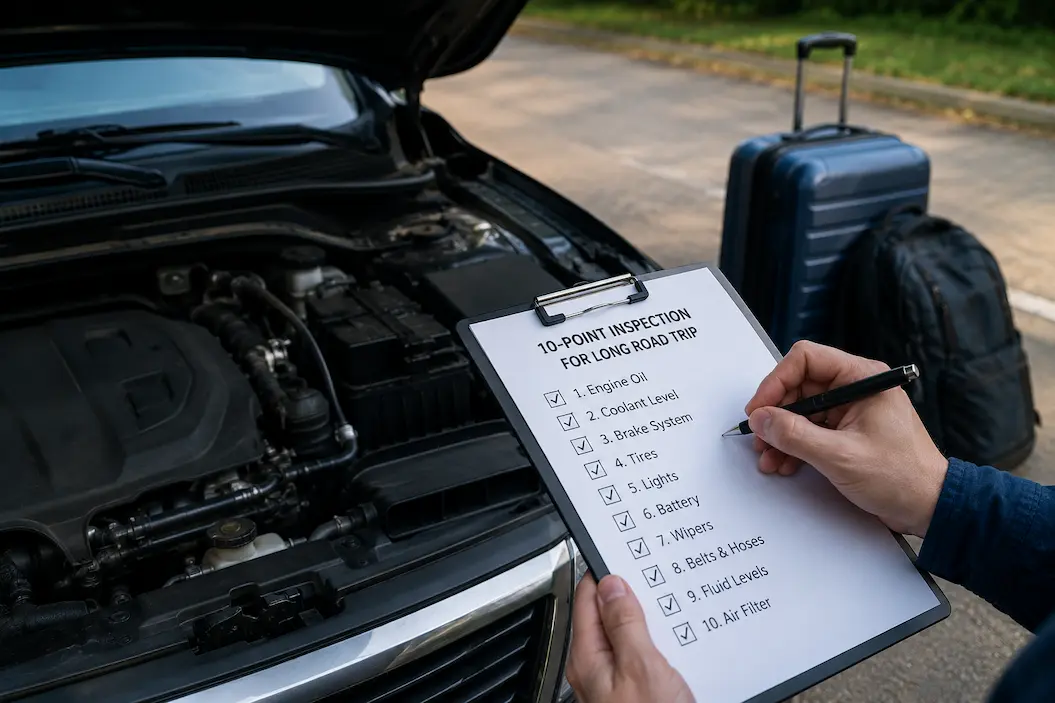
Since then, I have developed a pre-trip inspection routine that takes about forty-five minutes and has kept me from repeating that mistake. This is not about turning your garage into a mechanic shop. It is about catching the problems that matter before you are two hundred miles from the nearest town with a crying kid in the back seat and no cell signal.
Why a Pre-Trip Inspection Matters More Than You Think
Long road trips push your car harder than daily commuting. Sustained highway speeds generate more heat. Heavy loads strain the suspension and brakes. Remote stretches mean you cannot just pull into your usual shop if something goes wrong. A breakdown on a familiar street is an inconvenience. A breakdown on an unfamiliar mountain road at night is a genuine safety concern.
The good news is that most trip-ending failures are preventable with a basic inspection. The bad news is that most people skip it because they assume their car is fine since it drove to work yesterday without issue. Daily driving and a thousand-mile road trip are not the same thing.
Point 1: Check All Fluid Levels and Condition
This is where I start every time, and it is where most problems hide in plain sight.
- Engine oil: Pull the dipstick when the engine is cold. The level should be between the min and max marks. The color should be amber to dark brown. If it looks milky, smells like gasoline, or is below the minimum, address it before you leave. If you are close to your change interval, do it now. Fresh oil handles heat better than oil that is already degraded.
- Coolant: Check the overflow tank when the engine is cold. The level should be between the min and max lines. Look at the color. It should match what your manufacturer specifies, not a random rainbow of mixed coolants. If it is low, top it off with the correct type. If you do not know what is in there, a coolant test kit costs five dollars and tells you the freeze point and whether the mix is right.
- Brake fluid: The reservoir is usually near the firewall on the driver’s side. The fluid should be clear to light amber. Dark brown or black means it is absorbing moisture and needs changing. Low brake fluid can mean worn pads, which brings us to the next point.
- Power steering fluid: If your car has hydraulic power steering, check the level. Low fluid makes the pump work harder and can fail on long, winding roads where you are steering constantly.
- Windshield washer fluid: Top it off with a quality bug-removing formula. A dirty windshield at sunset on a highway is more dangerous than most people realize.
Pro Tip: Carry a quart of oil, a gallon of premixed coolant, and a small funnel in the trunk. Even if everything checks out before you leave, having supplies on hand means you can top off safely if a slow leak develops mid-trip.
Point 2: Inspect the Brakes
You do not need to remove the wheels for a basic pre-trip brake check. Look through the wheel spokes if you can see the pads. If the pad material looks thinner than a quarter inch, plan a replacement before you leave. Listen for squealing or grinding during normal stops. Feel for pulsing in the pedal, which suggests warped rotors.
Also check the parking brake. Engage it on a slight incline and make sure it holds the car firmly. A parking brake that slips on a hill at a rest stop is a problem you want to know about before you need it.
Point 3: Examine the Tires Thoroughly
Tires are your only contact with the road, and a blowout at seventy miles per hour is not something you want to experience. Here is what to check:
- Pressure: Use a quality gauge and check all four tires when they are cold. Inflate to the pressure listed on the driver’s door jamb, not the sidewall. Do not forget the spare.
- Tread depth: Insert a quarter into the tread groove. If you can see the top of Washington’s head, you are at about 4/32 of an inch, which is the minimum safe depth for wet conditions. For a long trip, I like to see at least 6/32.
- Damage: Look for cuts, bulges, exposed cords, or nails embedded in the tread. A bulge means the internal structure is compromised. Replace the tire immediately.
- Age: Check the DOT code on the sidewall. The last four digits are the week and year of manufacture. Tires older than six years should be inspected by a professional, even if the tread looks fine. Rubber degrades with age.
Point 4: Test the Battery
A battery that starts your car reliably in the driveway can struggle after hours of driving with the air conditioning, headlights, and phone chargers all drawing power. If your battery is more than three years old, have it load-tested at an auto parts store. It is free and takes five minutes.
While you are at it, clean any corrosion off the terminals. A wire brush and a mixture of baking soda and water do the job. Tighten the cable connections so they do not wiggle.
Point 5: Inspect Belts and Hoses
This is the inspection point that saved me from repeating my highway breakdown. Pop the hood and look at the serpentine belt. It should be tight with no cracks, fraying, or glazing. Press on it with your thumb. There should be about half an inch of deflection. More than that means the tensioner is weak.
Check the radiator hoses, heater hoses, and any small vacuum lines. Squeeze them. They should feel firm and spring back. Soft, mushy, or cracked hoses need replacement. Look for wet spots or crusty residue around hose clamps and connections. Any sign of seepage will get worse under the heat and pressure of sustained driving.
Warning: A serpentine belt failure on the highway means instant loss of power steering, alternator charging, and water pump circulation. The engine overheats within minutes. If your belt looks questionable, replace it before the trip. A $30 belt is cheaper than a tow and a ruined engine.
Point 6: Verify All Lights and Signals
Have someone stand outside the car while you cycle through headlights, high beams, turn signals, brake lights, and hazard flashers. Check the reverse lights too. A burned-out brake light is an invitation for a rear-end collision, and a police officer in an unfamiliar state is not likely to give you a warning.
Clean the headlight lenses if they are cloudy. Oxidized lenses reduce light output by up to 80 percent. A headlight restoration kit costs about fifteen dollars and makes a dramatic difference for night driving.
Point 7: Test the Air Conditioning
You might not think about the air conditioner until you are crawling through traffic in ninety-degree heat with the sun beating through the windshield. Turn it on and let it run for ten minutes. The air should be cold within a minute or two. If it is merely cool or takes a long time to get cold, you might have a refrigerant leak or a failing compressor.
A weak air conditioner is not just uncomfortable. It is a safety issue if you have passengers who are sensitive to heat, like young children or elderly travelers.
Point 8: Check the Suspension and Steering
With the car parked, grab each front tire at the nine and three o’clock positions and try to wiggle it. There should be no play. Do the same at twelve and six. Any movement suggests worn ball joints, tie rod ends, or wheel bearings. These are not parts you want failing at speed.
Take the car for a short drive on a road you know. Listen for clunks, rattles, or squeaks over bumps. Note whether the steering feels loose or the car pulls to one side. A car that wanders on the highway is exhausting to drive and dangerous in an emergency maneuver.
Point 9: Prepare an Emergency Kit
Even a perfectly inspected car can run over debris, suffer a puncture, or encounter a mechanical failure that has nothing to do with maintenance. Your emergency kit should include:
| Item | Why You Need It |
|---|---|
| Jumper cables or portable jump starter | Battery failure is the most common roadside issue |
| Spare tire, jack, and lug wrench | Verify the spare is inflated and the jack works before leaving |
| Tire pressure gauge | Check pressure daily on long trips; temperature changes affect it |
| Basic tool kit | Screwdrivers, pliers, adjustable wrench, duct tape, zip ties |
| Flashlight and extra batteries | Nighttime breakdowns are disorienting without light |
| First aid kit | Minor injuries happen; be prepared |
| Water and non-perishable snacks | If you are stranded for hours, hydration and energy matter |
| Phone charger and paper maps | GPS fails; cell service dies; paper does not need a battery |
| Blankets and rain gear | Weather changes; being cold and wet makes everything worse |
Point 10: Plan Your Route and Know Your Resources
This is not strictly mechanical, but it is part of trip preparation that too many people skip. Know where the major towns and services are along your route. Identify hospitals, auto parts stores, and dealerships for your make in case you need parts or service. Download offline maps for areas with spotty cell coverage.
Share your route and estimated arrival time with someone who is not on the trip. If you do not check in, they know where to start looking.
Pro Tip: Take a photo of your odometer reading, tire pressures, and fluid levels before you leave. If something changes mid-trip, you have a baseline to compare against. It also helps if you need to describe symptoms to a mechanic in an unfamiliar town.
What to Do If You Find a Problem
The whole point of this inspection is to find issues before they strand you. If you discover something concerning, you have three options:
- Fix it before you leave: This is the best option for anything safety-critical. Brakes, tires, belts, hoses, and cooling system problems should be resolved before you hit the road.
- Monitor it during the trip: Minor issues like a slightly low fluid level or a small oil seep can be managed if you check them at every fuel stop. Carry the supplies to top off.
- Change your plans: If the problem is serious and you cannot fix it in time, postpone the trip. A ruined vacation is expensive and disappointing. A ruined engine on a mountain highway is worse.
Final Thoughts
A long road trip is one of the great pleasures of car ownership. The open highway, the changing scenery, the sense of freedom. But that freedom depends on a machine that is up to the task. Forty-five minutes of methodical inspection before you leave can mean the difference between a trip you remember fondly and one you remember for all the wrong reasons.
I still think about that broken coolant hose sometimes. Not because of the money it cost, but because of the fear on my wife’s face when the temperature needle hit the red line with our kids in the back seat. That is why I do this inspection now. Every single time. And I have not had a trip-ending failure since.
Do the work. Check the fluids. Inspect the rubber. Test the brakes. Pack the kit. Then drive with confidence, knowing your car is as ready for the journey as you are.
Remember: The best roadside assistance is the kind you never need. A thorough pre-trip inspection is your insurance policy against the kind of breakdown that turns a vacation into a nightmare.
Related Articles
- Car Maintenance Guide: Prevent Breakdowns With Simple Routines
- How to Check and Replace Engine Oil Without Visiting a Mechanic
- Complete Brake System Maintenance: Pads, Rotors, Fluid, and Lines
- How to Rotate Tires Properly: Pattern, Frequency, and DIY Steps
- How to Maintain Tire Pressure for Better Fuel Efficiency
- Practical Tips to Extend the Life of Your Car’s Cooling System
- Car Battery Drains Overnight: Causes and Fixes
- Stepwise Method to Keep Your Car Battery Healthy in Winter
Sources and References
- NHTSA (National Highway Traffic Safety Administration). «Vehicle Maintenance and Safety for Long-Distance Travel.» https://www.nhtsa.gov/road-safety
- AAA (American Automobile Association). «Road Trip Vehicle Preparation Checklist.» https://www.aaa.com/automotive/road-trip-car-care
- Consumer Reports. «Pre-Trip Car Inspection Guide.» https://www.consumerreports.org/cro/cars/tires-car-care/pre-trip-inspection/index.htm
- Car and Driver. «How to Prep Your Car for a Road Trip.» https://www.caranddriver.com/features/a27169631/road-trip-car-prep/
- Popular Mechanics. «The Ultimate Road Trip Car Checklist.» https://www.popularmechanics.com/cars/how-to/a3110/1272411/
- Edmunds. «Road Trip Car Care: What to Check Before You Leave.» https://www.edmunds.com/car-maintenance/road-trip-prep.html
- U.S. Department of Transportation. «Summer Driving Safety Tips.» https://www.transportation.gov/summer-driving
- SAE International. «Vehicle Inspection Standards and Maintenance Protocols.» https://www.sae.org/standards/
About the author: This article was written by a hands-on automotive enthusiast with over fifteen years of experience maintaining personal vehicles, planning cross-country road trips, and helping friends avoid roadside breakdowns. All recommendations are based on practical field experience combined with manufacturer guidelines and industry safety standards.

Written by Michael Reyes, part of the FallasDeAutos editorial team. Michael focuses on helping car owners understand and fix common vehicle problems with simple, practical guidance. His content covers diagnostics, maintenance, and troubleshooting, making complex automotive issues easier to understand. He aims to provide clear, reliable information that helps readers make informed decisions while encouraging consultation with qualified mechanics when needed.