
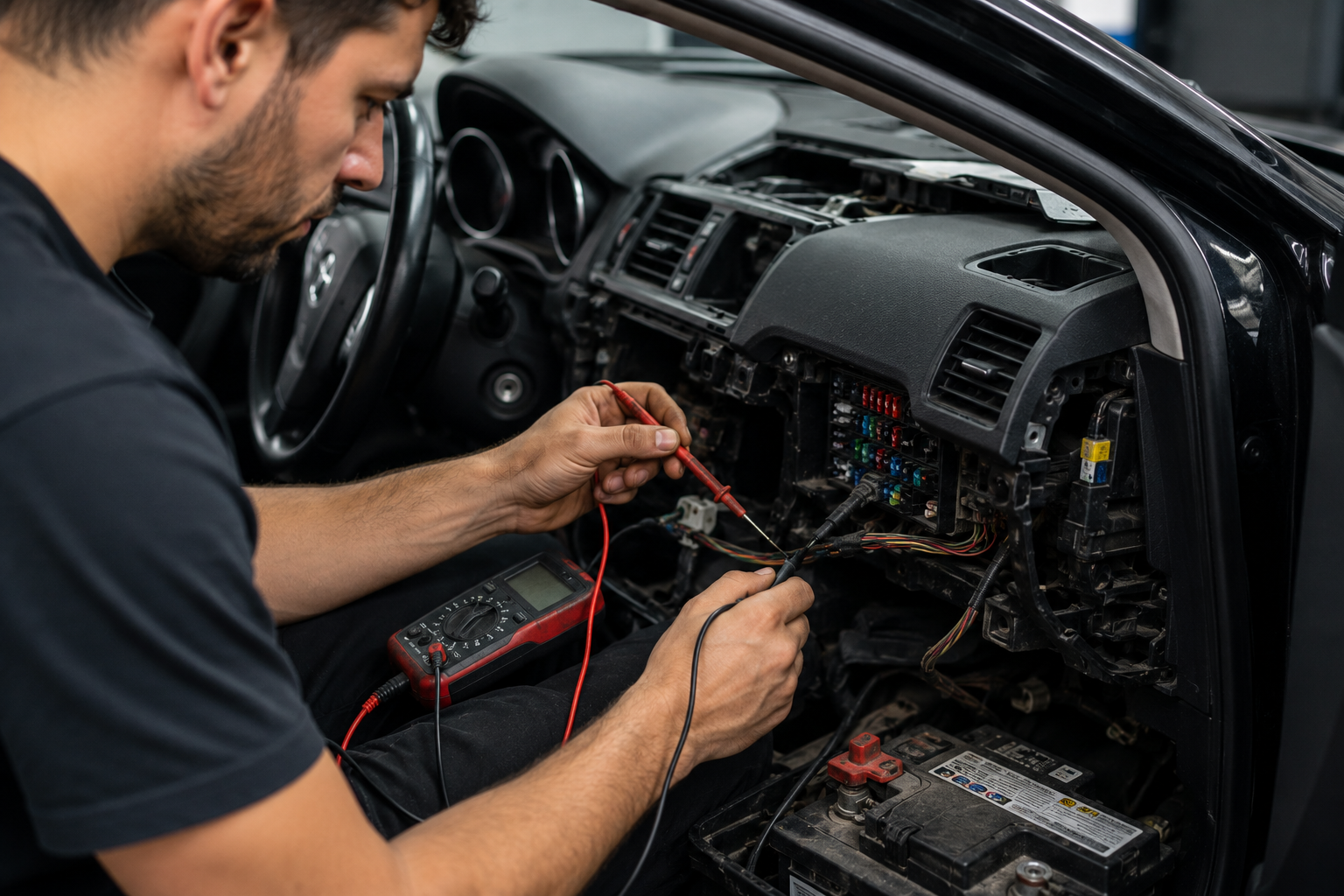
I still remember the moment clearly. I turned the key like I always do on a normal morning, expecting the usual crank and engine sound—but instead, I got nothing. Not even a click. The dashboard didn’t light up properly, the radio stayed dead, and even the interior lights flickered like they were unsure whether to stay on or off.
At first, I thought it was just a weak battery. That’s the usual suspect, right? But what confused me was how suddenly everything failed. The night before, the car was running perfectly fine. No warning signs, no dim lights, no strange behavior. It was just a clean shutdown after parking. That moment marked the beginning of my deep dive into tracing sudden power loss in car electronics—a process that taught me more about automotive electrical systems than any manual ever could. What I learned is simple: car electrical issues rarely come from one big failure. Instead, they hide in small, overlooked places.
Understanding the Early Warning Signs Most Drivers Ignore
Before a full breakdown happens, your car usually whispers hints. The problem is, most of us don’t notice them or don’t connect the dots until it’s too late. When I started paying attention after my own incident, I realized there were subtle signs I had ignored earlier:
- Dashboard lights flickering slightly when starting the engine
- Radio resetting randomly
- Power windows moving slower than usual
- Interior lights dimming when turning on AC or headlights
- A faint burning smell near fuse box area (in some cases)
These signs don’t always scream “electrical failure,” but they quietly point toward instability in the car’s power distribution system. What I learned is that sudden power loss in car electronics rarely happens suddenly—it builds up silently.
Starting With the Basics: Battery Health and Terminal Connections
The first thing I checked was the battery, because honestly, that’s where everyone starts—and rightly so. I removed the battery cover and noticed something small but important: corrosion around the terminals. It wasn’t extreme, but enough to interfere with consistent power flow.
Here’s what I did step-by-step:
- Cleaned both terminals using a baking soda and water solution
- Tightened the terminal clamps properly
- Checked battery voltage with a multimeter (it was borderline low)
- Ensured no loose connections at the grounding point
One thing I learned quickly: a battery can be “alive” but still fail under load. That means it might show good voltage but collapse when the car demands real power. In my case, the battery wasn’t the only issue—but it was definitely part of the chain reaction.
The Hidden Trouble Makers: Fuses and Relays You Don’t Think About
After the battery check, I moved on to the fuse box. This is where things got interesting. Most people assume fuses only blow completely and stop working. But I found that sometimes they become partially damaged or loose in their socket, causing intermittent power loss.
I started checking:
- Main fuses (especially ECU and ignition fuses)
- Relay switches for fuel pump and ignition system
- Any signs of heat damage or discoloration
What surprised me most was a slightly loose relay. It wasn’t burned or broken—it was just not seated properly. That small issue was enough to cause random electrical shutdowns. After reseating the relay, I noticed a slight improvement, but the problem wasn’t fully gone. That told me I was only halfway through the diagnosis.
Grounding Issues: The Most Overlooked Cause of Electrical Chaos
If I had to choose the most ignored cause of car electrical problems, it would be grounding. A weak ground connection can mimic almost every electrical issue in the book. It can make you think your battery is bad, your alternator is failing, or even that your ECU is damaged.
I inspected the grounding cables next:
- Battery to chassis ground
- Engine block grounding strap
- Connection points for corrosion or looseness
And here’s what I found: a slightly rusted engine ground connection. It didn’t look like a big deal at first glance, but when I cleaned and tightened it, the electrical system immediately became more stable. That moment taught me something important: electricity in cars is not just about power—it’s about return paths too. Without a strong ground, the whole system becomes unpredictable.
Checking the Alternator: Is the Car Actually Charging Properly?
After stabilizing the basic connections, I turned to the alternator—the heart of the charging system. A failing alternator doesn’t always stop working completely. Sometimes it produces inconsistent voltage, which leads to strange electrical behavior.
Using a multimeter, I checked:
- Voltage while engine off
- Voltage at idle
- Voltage under load (AC, headlights, music system on)
The readings were slightly unstable. Not completely dead, but not healthy either. This explained a lot. A weak alternator can slowly drain the battery even while driving, which eventually leads to sudden electronic failure when the system can’t sustain load anymore. I didn’t replace it immediately, but I added it to the list of probable causes.
Wiring Harness and Hidden Faults That Take Time to Reveal
Once the obvious parts were checked, I moved to something more complicated—the wiring harness. This is where most DIY troubleshooting becomes tricky. Car wiring runs through tight spaces, bends around metal edges, and is exposed to heat and vibration for years. Over time, insulation can crack or wires can partially break inside the sleeve without any visible damage.
I carefully inspected the following:
- Areas near the engine bay where heat is high
- Wiring under the dashboard
- Points where wires bend frequently
- Signs of rodent damage or wear
I didn’t find a complete break, but I did find a slightly worn section of wiring near a junction point. It wasn’t fully damaged, but it had signs of stress. Even minor wiring resistance can create intermittent power issues, especially in modern cars packed with electronics.
The Step-by-Step Routine I Now Follow for Electrical Issues
After going through this experience, I developed a simple routine that I now follow whenever I face sudden power loss in car electronics.
It looks like this:
Step 1: Battery First
- Check voltage
- Clean terminals
- Test under load
Step 2: Fuse Box Inspection
- Main fuses
- ECU-related relays
- Physical fit and heat damage
Step 3: Ground Connections
- Battery ground
- Engine ground
- Chassis grounding points
Step 4: Alternator Check
- Voltage output at idle
- Load testing with accessories on
Step 5: Wiring Inspection
- Visible wear and tear
- Heat-exposed sections
- Loose connectors
This sequence saves time and avoids random guessing, which is what usually makes electrical troubleshooting frustrating.
What Finally Solved My Car’s Electrical Mystery
In my case, the issue wasn’t just one thing—it was a combination.
- Slightly weak battery
- Loose relay connection
- Corroded ground point
- Marginal alternator performance
Individually, none of them seemed catastrophic. But together, they created a situation where the car electronics would randomly lose power or fail to start. After cleaning the grounds, securing the relay, and replacing the battery, the car came back to life fully stable. No flickering. No random shutdowns. Just normal operation again. That experience changed how I look at car electrical problems forever.
Conclusion
If there’s one lesson I took from this entire experience, it’s that car electrical systems don’t fail in dramatic ways most of the time—they degrade quietly. Sudden power loss in car electronics is usually the result of small issues stacking together: weak battery health, poor grounding, unstable alternator output, or even a loose relay. The key is not to panic or start replacing expensive parts immediately. Instead, follow a logical step-by-step approach and start with the simplest checks first. Most of the time, the solution is already sitting in front of you—it just takes patience and a systematic mindset to find it.
FAQs
1. What is the most common cause of sudden power loss in car electronics?
The most common causes are weak battery connections, poor grounding, or a failing alternator. These three work together more often than people realize.
2. Can a bad alternator cause complete electrical shutdown?
Yes. A failing alternator can stop charging the battery properly, eventually leading to complete loss of electrical power while driving or starting.
3. How do I know if it’s a battery or alternator problem?
If the car starts but dies soon after, it’s often the alternator. If it doesn’t start at all, the battery or connections are usually the issue.
4. Are grounding problems really that serious?
Absolutely. Poor grounding can cause random electrical failures, flickering lights, and even sensor malfunctions that look like major faults.
5. Should I go to a mechanic or try diagnosing it myself?
Basic checks like battery, fuses, and visible wiring can be done at home. But if the issue persists, a professional diagnostic scan is the safest option.

Written by Michael Reyes, part of the FallasDeAutos editorial team. Michael focuses on helping car owners understand and fix common vehicle problems with simple, practical guidance. His content covers diagnostics, maintenance, and troubleshooting, making complex automotive issues easier to understand. He aims to provide clear, reliable information that helps readers make informed decisions while encouraging consultation with qualified mechanics when needed.