
It didn’t start with a breakdown or a warning light. It started with something far more confusing—subtle changes in how the car behaved. One morning, the engine felt slightly rough at idle. The next day, the headlights seemed a bit dimmer than usual when I started the car. A few days later, the radio restarted randomly while I was driving.
At first, none of it felt serious. Cars sometimes behave somewhat differently, right?
But when multiple small issues started appearing together, I knew something deeper was going on. That’s when I first came across a problem many drivers overlook completely: weak ground connections affecting car performance. What I didn’t realize at the time was that something as simple as a loose or corroded ground point could disrupt almost every electrical system in the vehicle.
Understanding Why Ground Connections Matter More Than Most Drivers Realize
Most people think car problems come from batteries, alternators, or sensors. Ground connections rarely get attention—but they are just as important as the power supply itself. A car’s electrical system works on a simple principle: electricity flows from the battery, powers components, and then returns back through the ground.
If that return path is weak, everything becomes unstable.
A weak ground connection can cause the following:
- Random electrical glitches
- Poor engine performance
- Dim or flickering lights
- Hard starting issues
- Unstable sensor readings
What surprised me most was how one small ground point could affect multiple systems at the same time. It’s not just one symptom—it’s a chain reaction across the entire car.
My First Miss diagnosis: Blaming the Battery for Everything
Like most drivers, I started with the battery. It made sense at the time. The symptoms looked electrical, and the battery is usually the first suspect.
So I did what many people do:
- Checked voltage
- Cleaned terminals
- Even considered replacing it
For a short time, things seemed slightly better. But the problems came back within days.
That’s when I realized something important: a healthy battery cannot fix a bad ground connection.
The battery was doing its job. The issue was the path through which the electricity was trying to return.
The Early Signs of a Weak Ground Connection I Overlooked
Looking back, the signs were there all along. I just didn’t recognize them as grounding issues.
Some of the early symptoms included:
- Engine cranking slightly slower than usual
- Dashboard lights flickering during startup
- Radio resetting when AC was turned on
- Slight hesitation during acceleration
- Random warning lights appearing and disappearing
None of these felt connected at first. But that’s the tricky part about weak ground connections—they mimic multiple unrelated problems.
It only becomes clear when you step back and look at the pattern instead of individual symptoms.
How I Started Systematically Checking Ground Points in My Car
Once I suspected grounding issues, I stopped guessing and started inspecting methodically.
Most cars have several important ground points:
- Battery negative terminal to chassis
- Engine block grounding strap
- Transmission grounding points
- Body frame grounding locations
- ECU grounding connections
I began with the easiest check: the battery ground cable.
At first glance, it looked fine. But when I removed it, I noticed a thin layer of corrosion underneath the connector that wasn’t visible from outside.
That small layer was enough to restrict smooth electrical flow.
After cleaning it properly, I noticed an immediate improvement in starting behavior—but the issue wasn’t fully gone yet.
That told me there was more than one weak ground point involved.
The Hidden Engine Ground Strap Problem I Almost Missed
The second breakthrough came when I inspected the engine ground strap.
This cable connects the engine block directly to the chassis, ensuring stable current flow for ignition and sensors.
In my case, the strap looked physically intact—but when I tested it, I noticed inconsistent conductivity.
The issue wasn’t visible damage. It was internal resistance caused by aging and heat exposure.
This is what makes weak ground connections so tricky—you can’t always see the problem.
Once I replaced and tightened the engine ground strap, the car immediately felt more stable:
- Smoother idle
- Stronger engine response
- More stable electronics
But I still wanted to be sure nothing else was contributing.
How Weak Ground Connections Affect Engine Performance in Real Driving
After fixing the obvious grounding issues, I started noticing just how much damage they had been causing.
Weak ground connections don’t just affect electronics—they impact engine behavior too.
Here’s how I experienced it firsthand:
1. Irregular Ignition Timing Feel
The engine didn’t misfire completely, but it felt uneven at low speeds. That was caused by inconsistent sensor grounding.
2. Reduced Acceleration Response
Pressing the accelerator didn’t always result in smooth power delivery. The ECU was getting unstable voltage references.
3. Sensor Miscommunication
Some sensors rely heavily on ground stability. When that fluctuates, the ECU receives incorrect readings.
This is why grounding issues can feel like fuel or engine problems even when nothing mechanical is wrong.
The Simple Voltage Drop Test That Changed Everything
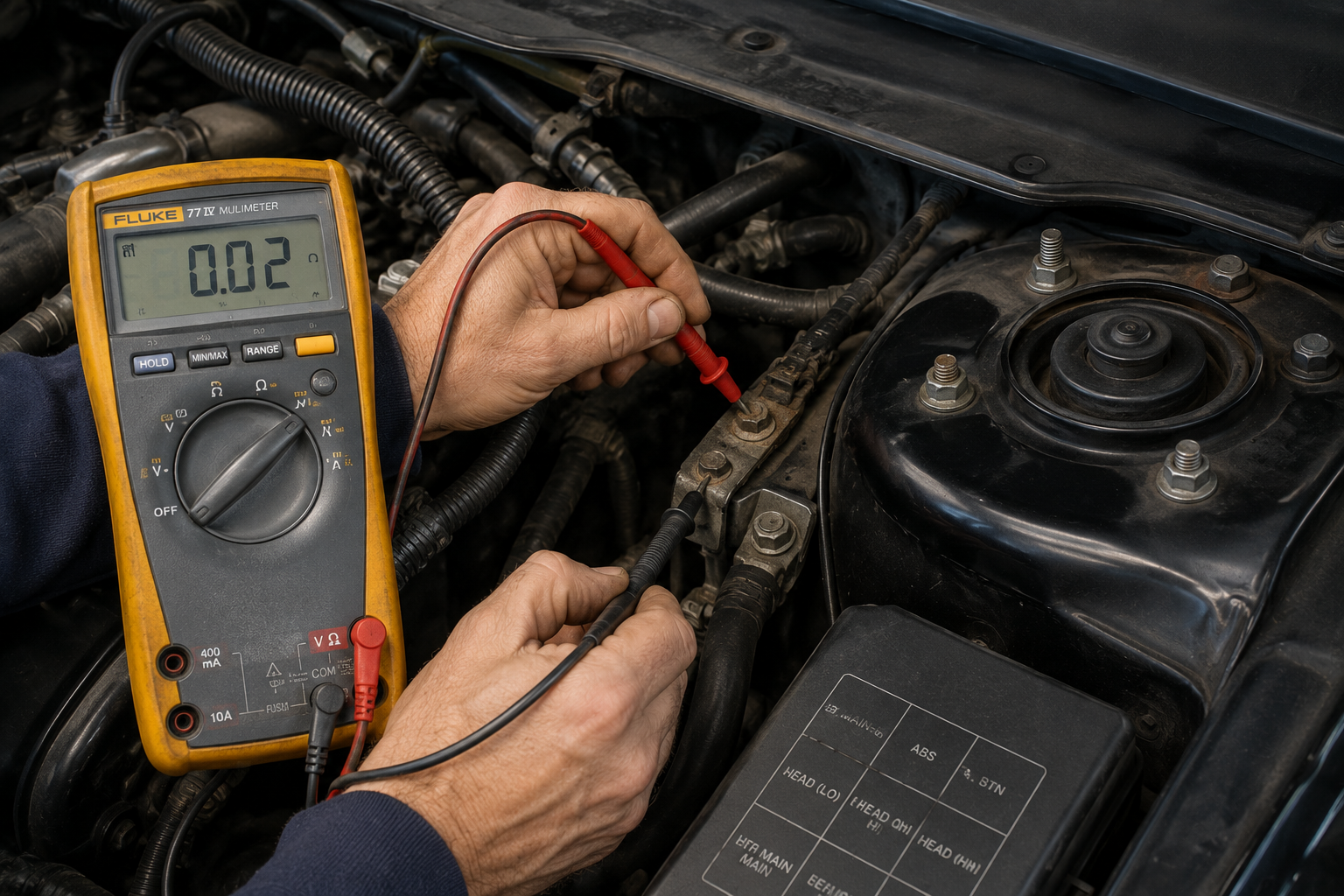
One of the most useful steps I learned was the voltage drop test.
Instead of just checking voltage at the battery, I measured the difference between the following:
- Battery negative terminal
- Engine block
- Chassis ground points
Even a small voltage difference under load can indicate resistance in the ground path. In my case, I found a noticeable drop when electrical accessories were turned on.
That confirmed what I suspected: not all ground points were performing equally.
Common Causes of Weak Ground Connections in Cars
After fixing my car, I started understanding how these issues develop in the first place.
Most weak ground problems come from the following:
- Corrosion due to moisture exposure
- Loose bolts or connectors
- Heat damage in engine bay areas
- Aging wiring insulation
- Poor aftermarket electrical installations
Even something as simple as engine vibration over time can slowly loosen ground connections without anyone noticing.
Practical Steps I Now Follow to Prevent Ground Issues
After this experience, I developed a simple routine to prevent grounding problems before they start.
Regular Inspection Points
- Battery terminals every few months
- Engine ground strap condition
- Visible wiring near engine heat zones
Cleaning Routine
- Remove corrosion using a wire brush
- Apply dielectric grease to prevent future oxidation
- Tighten all grounding bolts properly
Electrical Load Testing
- Turn on headlights, AC, and radio together
- Check for flickering or instability
- Observe engine behavior under load
These simple habits help catch problems early before they turn into performance issues.
The Moment Everything Became Clear and Stable Again
After cleaning and securing all major ground connections, the transformation was immediate.
The car that once felt unpredictable suddenly became stable again:
- No more flickering lights
- Smooth engine start every time
- Strong and consistent acceleration
- No random electrical resets
What seemed like multiple unrelated issues turned out to be one root cause: weak ground connections affecting car performance.
It was a reminder that sometimes the simplest components create the most significant problems.
Conclusion
Weak ground connections are one of the most overlooked causes of car performance issues. They don’t always break completely—they degrade slowly, quietly affecting multiple systems at once. From my experience, the biggest lesson is this: don’t rush into replacing parts when electrical problems appear. Instead, start with the fundamentals—battery, grounding, and wiring integrity.
Once ground connections are stable, many “mysterious” car issues simply disappear. Understanding these fundamentals not only saves money but also gives you confidence in diagnosing problems the right way.
FAQs
1. What are the symptoms of a weak ground connection in a car?
Common symptoms include flickering lights, difficulty starting, unstable engine performance, and random electrical glitches.
2. Can a poor ground connection affect engine performance?
Yes, it can cause poor ignition timing, reduced acceleration, and sensor miscommunication with the ECU.
3. How do I test a car’s ground connection?
You can use a multimeter to perform a voltage drop test between the battery negative terminal and engine/chassis points.
4. Where are the main ground points in a car?
Key ground points include the battery negative terminal, engine block strap, chassis connections, and ECU grounding points.
5. How often should ground connections be checked?
It’s a good practice to inspect them every few months or during regular car maintenance, especially in humid or dusty environments.

Written by Michael Reyes, part of the FallasDeAutos editorial team. Michael focuses on helping car owners understand and fix common vehicle problems with simple, practical guidance. His content covers diagnostics, maintenance, and troubleshooting, making complex automotive issues easier to understand. He aims to provide clear, reliable information that helps readers make informed decisions while encouraging consultation with qualified mechanics when needed.