
That Slight Hesitation Your Customer Feels? The Numbers Know Before the Light Does
Every mechanic has been there. A customer drops off a car complaining about a rough idle, a stumble under acceleration, or fuel economy that has quietly gone downhill. You take it for a spin, you plug in your scanner, and the screen stares back at you with zero codes. Nothing. The diagnostic engine light is off, the monitors are all complete, and the car feels fine in your bay.
So you hand it back, maybe suggest a tune-up, and see what happens. Two weeks later, the customer is back with the same complaint. This cycle is expensive for everyone, and it is completely avoidable if you know where to look.
The truth is, your engine control module is already aware of the problem. It has been compensating for it for days, maybe even weeks. It just has not reached the threshold where it decides to turn on the light. The evidence is sitting in your fuel trim data, and if you learn to read it, you can spot engine problems months before they ever throw a code.
What Fuel Trim Actually Tells You
At its core, fuel trim is a report card on how hard the computer is working to keep the air-fuel mixture correct. The ideal ratio is 14.7 parts air to one part fuel. That is the stoichiometric target the oxygen sensor is chasing. When everything is perfect, the computer does not need to add or subtract fuel, and your fuel trim reads close to zero.
But engines are rarely perfect. Sensors drift, injectors clog, vacuum lines crack, and mass airflow sensors get dirty. The computer’s job is to compensate for these issues by adjusting the fuel injector pulse width. If it needs to add fuel, the trim goes positive. If it needs to cut fuel, the trim goes negative.
The key insight is this: the computer is not just reacting to a problem. It is documenting one. Those trim numbers are a running log of how far the engine has drifted from ideal and how aggressively the computer is fighting to cover it up.
Short Term vs Long Term: Two Different Stories
There are two types of fuel trim, and they behave very differently. Understanding the distinction is what separates a parts swapper from a real diagnostician.
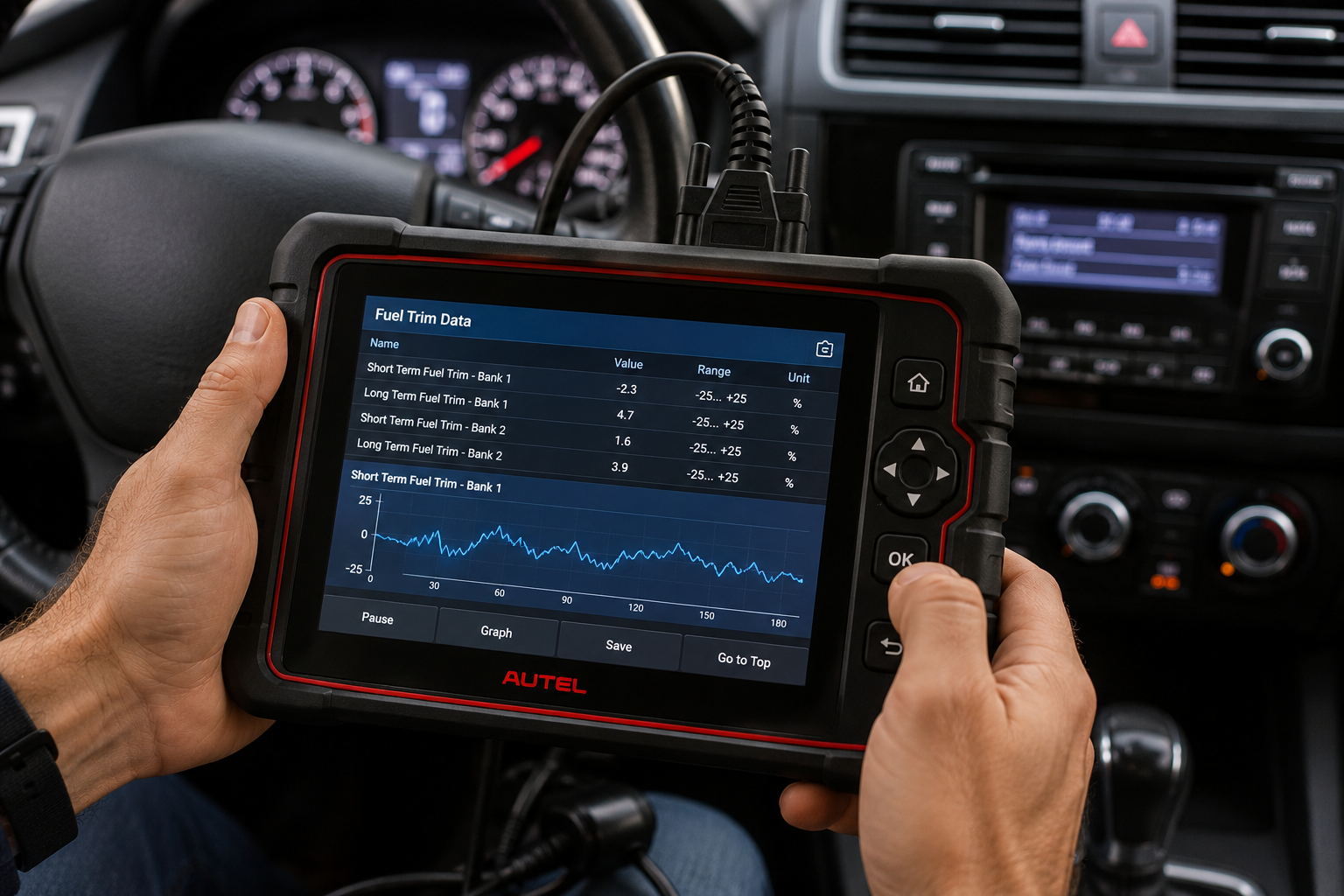
Short-term fuel trim, or STFT, is the computer’s immediate reaction. It changes in real time based on what the oxygen sensor is seeing right now. If you watch it on a scanner, it bounces around constantly. Step on the gas; it goes positive. Lift off, and it goes negative. Turn on the air conditioning, and you will see a blip. It is live feedback, and it resets every time you shut off the engine.
Long-term fuel trim, or LTFT, is the bigger picture. It is a learned value that the computer builds over multiple drive cycles. It represents the average correction the computer has decided it needs to keep the mixture in range. Unlike short-term, LTFT is stored in memory. It survives key-off. It is the computer’s admission that something is chronically wrong.
Think of it like a thermostat. STFT is the moment-to-moment adjustment as the sun comes through the window. LTFT is the realization that someone left the front door open, and you now need to run the heater three degrees higher all winter just to maintain the same temperature.
Reading the Numbers: What Is Normal and What Is Not
Here is where many people get tripped up. Small variations are completely normal. A fuel trim bouncing between plus and minus five percent is a healthy engine doing its job. The computer is allowed to make minor corrections, and it does so constantly.
The danger zone starts when the numbers stay consistently outside that range. If your short term is hanging around positive fifteen percent at idle, that is not a normal variation. That is the computer dumping in extra fuel to compensate for a lean condition. If your long term has crept up to positive twenty percent, the computer has essentially given up on the base fuel map and is running a permanent correction.
The general rule of thumb most technicians use is this: short-term should stay within plus or minus ten percent under normal conditions. Long-term should stay within plus or minus ten percent, with fifteen percent being the absolute ceiling before you are looking at serious problems. When the total of both trims together exceeds ten percent, you have a real issue that needs investigation.
Some manufacturers use a slightly different scale where 128 represents zero. Anything above 128 is lean; anything below is rich. If your scanner shows numbers in that range, just check your service information for the specific scale your vehicle uses.
| Total Fuel Trim Reading | What It Means | Typical Root Cause |
|---|---|---|
| 0% to ±5% | Healthy engine, normal compensation | No action needed |
| ±5% to ±10% | Minor drift, worth monitoring | Slight vacuum leak, aging sensor, dirty filter |
| ±10% to ±15% | Developing problem, likely no codes yet | Vacuum leak, MAF contamination, weak fuel pump |
| ±15% to ±20% | Serious compensation, codes likely soon | Significant leak, failing injector, fuel pressure issue |
| Over ±20% | Critical, check engine light probable | Major system failure, immediate diagnosis required |
Why Positive Trims Are the Most Common Early Warning
In my experience, positive fuel trims are what you see first on a car that is starting to go downhill. A positive trim means the computer is adding fuel. That points to a lean condition, and lean conditions are usually caused by unmetered air entering the engine somewhere after the mass airflow sensor.
The classic culprit is a vacuum leak. A cracked hose, a loose intake manifold gasket, a leaking PCV valve, or a stuck purge solenoid can all dump extra air into the cylinders that the MAF never measured. The computer sees a lean exhaust signal from the oxygen sensor and adds fuel to compensate. The driver feels a rough idle or a hesitation. The scanner shows positive trims. No code has been set yet because the oxygen sensor is still switching, and the computer is still able to keep the mixture in range by working harder.
Another common cause is a dirty or failing MAF sensor. If the sensor is underestimating the actual airflow, the computer calculates fuel delivery based on a number that is too low. The result is a lean mixture, positive trims, and eventually a stumble that the customer notices but the computer has not yet flagged as a hard fault.
Weak fuel delivery can also show up as positive trims. If the fuel pump is tired, the filter is clogged, or the injectors are restricted, the engine is not getting enough fuel for the air it is breathing. The computer sees lean and adds fuel. The trims climb. The driver notices poor acceleration. The light stays off because the computer is still hitting the target, just barely.
Negative Trims: When the Engine Is Drowning in Fuel
Negative fuel trims are less common in the early stages, but they are just as telling. A negative trim means the computer is pulling fuel out. The engine is running rich. Something is causing too much fuel or too little air.
Leaking injectors are a prime suspect. If an injector dribbles fuel when it should be fully closed, that extra fuel hits the cylinder and shows up as a rich exhaust signal. The computer cuts fuel to compensate. The trims go negative. The customer might complain about black smoke, a fuel smell, or unusually high fuel consumption.
A contaminated or failing MAF sensor can also cause negative trims, but this time it is over-reporting airflow. The computer thinks more air is entering than actually is, so it commands more fuel than needed. The mixture goes rich. The trims go negative. The oxygen sensor reports rich. The computer pulls fuel back. The cycle continues.
Excessive fuel pressure is another possibility. If the pressure regulator is stuck or the return line is restricted, the injectors spray more fuel than the pulse width calls for. The computer sees richness and compensates with negative trims. This one can be dangerous because high pressure can wash down cylinder walls and cause oil dilution over time.
How to Test Fuel Trim Properly
Reading fuel trim is not as simple as plugging in and glancing at the numbers. You need the engine fully warm and in closed-loop operation. If the oxygen sensor has not reached operating temperature, the computer is running on preset maps, and the fuel trim data is meaningless. Wait until the coolant is above 180 degrees and the scanner confirms closed-loop status.
Once you are there, do not just look idly. Idle is only one operating condition, and it is often the least revealing. A vacuum leak might scream at idle but calm down at cruise. A fuel delivery problem might hide at idle but show up under load. You need to see the full picture.
Record your short-term and long-term trims at idle, at 1500 RPM, at 2500 RPM, and during a light acceleration. Then take the car for a road test and watch the numbers at steady highway speed. If you have a V-engine, compare bank one and bank two. A difference between banks is a huge clue that points you to one side of the engine.
Here is a practical test that costs nothing and tells you a lot. If you suspect a vacuum leak and your trims are highly positive at idle, raise the engine speed to about 2000 RPM and hold it steady for thirty seconds. If the fuel trims drop back toward normal, you almost certainly have a small vacuum leak. At higher RPM, the intake vacuum decreases, and the leak has less effect. The computer needs less compensation. The trims come down. It is a simple, reliable test that has saved me hours of smoke testing.
The Real Value: Catching Problems Before the Customer Does
The most powerful thing about fuel trim data is that it reveals problems the driver has not even noticed yet. A customer might bring a car in for a routine oil change with no complaints at all. You pull the data, and the long-term trend is sitting at positive twelve percent. The engine is not throwing a code. The light is off. The customer thinks everything is fine.
But you know better. That twelve percent is a cry for help. It means the engine is working harder than it should, fuel economy is already suffering, and the catalyst is being exposed to excess oxygen that will eventually damage it. You have found a problem that would have turned into a $1,500 catalytic converter replacement in six months. Now it is a $20 vacuum hose.
This is the kind of diagnostic work that builds trust. Customers do not always understand what fuel trim is, but they understand when you find something before it breaks. They understand when you save them money. And they come back because they know you are not just reading codes and guessing.
Common Traps That Waste Your Time
Even with good data, it is easy to chase your tail if you are not careful. One of the biggest mistakes is testing a cold engine. Cold fuel trim numbers are all over the place because the computer is deliberately running rich for startup. You will see wild swings that mean nothing. Always warm the engine first.
Another trap is clearing the computer’s memory before you diagnose. When you disconnect the battery or clear codes with a scanner, you wipe the long-term fuel trim back to zero. The computer has to relearn everything. If the underlying problem is still there, the trims will start climbing again, but you have lost your historical data. You cannot see how bad it was before. Record everything first, then clear if you need to.
Do not forget to verify your sensors before you trust the trims. If the oxygen sensor is lazy or the MAF is completely dead, the fuel trim data is garbage. The computer is making corrections based on bad information. A quick functional test of the oxygen sensor with propane enrichment or a vacuum pull and a check of MAF response during a snap throttle test will confirm your inputs are honest before you spend time interpreting the outputs.
Putting It All Together
Fuel trim is not a magic bullet, but it is one of the most honest pieces of data your scanner gives you. It is the computer’s own confession about what is really going on inside the engine. Codes are binary. They tell you a threshold was crossed. Fuel trim is analog. It shows you the journey toward that threshold, and it lets you intervene before the trip ends in a breakdown.
The next time a car rolls in with a vague drivability complaint and no codes, do not shrug and send it away. Pull up the fuel trim data. Read the story the numbers are telling. Look at the short term for immediate reactions, the long term for chronic trends, and the total picture for direction. The engine is already talking. You just need to know how to listen.
Sources and References
- Tomorrow’s Technician. «Drivability Issues: Fuel Trim Diagnostics.» March 31, 2022. https://www.tomorrowstechnician.com/drivability-issues-fuel-trim-diagnostics/
- MOTOR Magazine. «Fuel Trim Data: A Powerful Diagnostic Tool.» July 9, 2024. https://www.motor.com/magazine-summary/fuel-trim-data-powerful-diagnostic-tool/
- FleetRabbit. «How to Read Fuel Trim with an OBD-II Scanner.» August 2, 2025. https://fleetrabbit.com/blogs/post/how-to-read-fuel-trim-with-an-obd-ii-scanner
- Auto Technician. «Fuel Trim Analysis.» April 1, 2025. https://autotechnician.co.uk/fuel-trim-analysis/
- Trade Mechanic. «Understanding Short Term and Long Term Fuel Trims.» March 15, 2019. https://trade.mechanic.com.au/news/understanding-short-term-and-long-term-fuel-trims1
- Diagnostic Network. «Fuel Trim for Driveability.» https://diag.net/msg/m6dd30cz5ztppi9fin9e9vcz7h

Written by Michael Reyes, part of the FallasDeAutos editorial team. Michael focuses on helping car owners understand and fix common vehicle problems with simple, practical guidance. His content covers diagnostics, maintenance, and troubleshooting, making complex automotive issues easier to understand. He aims to provide clear, reliable information that helps readers make informed decisions while encouraging consultation with qualified mechanics when needed.